
I. The Half-Hour Truce
There is a particular kind of quiet that only exists in the thirty minutes before you have to stop being quiet. This morning it belonged to the Royal Botanic Garden in Sydney, where spring sun sat on my face like something owed to me, where a coffee cooled slowly in my hand, and where a book lay open on my lap doing more work than I was. In half an hour I would be back at a desk, dealing with the ordinary weather of an office: emails demanding to be read as though they were weather warnings, meetings that exist mainly to schedule other meetings, and the small frictions that dress themselves up as urgent business because urgency is the only currency that gets attention anymore. For those thirty minutes, though, the city was still far enough away that I could hear the harbour and the birds instead of the inbox. That distinction – harbour versus inbox, birdsong versus notification – is not a small one. It is, I think, the difference between a life and a schedule.
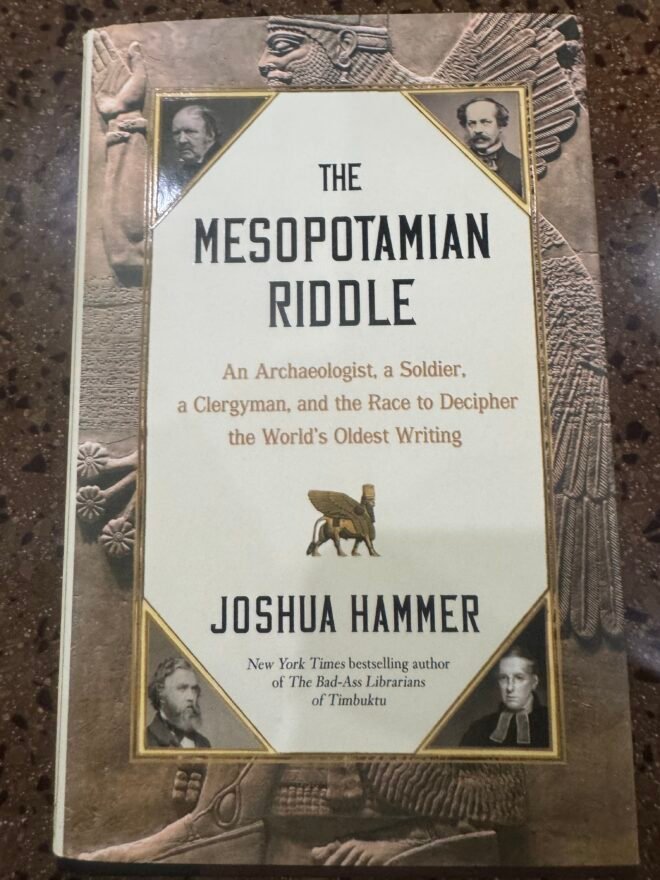
The book responsible for the quiet was Joshua Hammer’s The Mesopotamian Riddle. On its surface it is a race – an archaeologist, a soldier, a clergyman, each chasing the same prize through the same century. But underneath the race is something considerably older and considerably stranger: the story of the moment human beings first learned to press thought into clay, and of what those first recorded lives actually sounded like once the script that held them was finally cracked open after the better part of two thousand years of silence.
Hammer’s opening has stayed with me since I read it, in the way certain sentences do – not because they are ornate, but because they ask a question you did not know you were carrying. He sets the scene in London in 1857, an era drunk on its own idea of progress, watching in fascination as strange palaces emerged from the sands of the Middle East. Assyria. Babylon. The mighty Persian Empire. For a Victorian public raised on the Bible and on Herodotus, these were not neutral names. They were the villains of two founding stories at once – the great antagonists of both ancient Greece and ancient Israel, the empires that sacked, exiled, and conquered the peoples whose own accounts had survived to tell the tale.
And so the question that animates the book, and that has been sitting with me ever since: what did these “bad guys” of Western history have to say for themselves? What were their values, their rituals, their sense of where they stood in the order of the universe? What was it actually like to be a human being at the dawn of recorded history, rather than a human being as described by the people who buried them?
That last question is the one that keeps catching me this morning, under a jacaranda not yet in flower, with a stolen half hour ticking down. We like to believe the present is uniquely noisy – that we, of all generations, are the ones drowning in information, obligation, and grievance. Then you sit under a tree in September with thirty minutes borrowed from an employer, and you remember how old the habit actually is. People building cities. Keeping accounts. Arguing. Praying. Writing their names into wet clay so that they would not simply vanish into the ground they walked on. The Victorians wanted to know what the “other side” of history had to say for itself. That is a reasonable ambition. Mine is smaller and, I suspect, more selfish: I want to know how much of this – the coffee, the borrowed quiet, the reluctance to go back inside – would have been recognisable to someone standing on a rooftop in Nineveh three thousand years ago, watching the light change over the Tigris before a day of ledgers and litigation began.
Probably more of it than we like to admit.
II. The Bad Guys of History
It is worth sitting with why Assyria and Babylon needed rehabilitating at all. For most of the last two and a half thousand years, the only sources available to the West on Mesopotamian civilisation were the sources of its enemies and its victims. The Hebrew Bible remembers Assyria as the rod of God’s anger, the empire that scattered the northern kingdom of Israel and never gave it back. It remembers Babylon as the city of exile, the place where a conquered people sat down and wept when they remembered Zion, and where a tyrant’s hand wrote judgment on a palace wall in the middle of a feast. Classical Greek historians, writing centuries after the fact and with their own civilisational anxieties to manage, remembered the Persian Empire chiefly as the vast, decadent, despotic power that Greek liberty had heroically turned back at Marathon and Salamis – the great foil against which an entire idea of the West could be defined.
None of this is exactly false. Empires did what empires do, and the Assyrians in particular built a reputation for calculated brutality that their own inscriptions do not entirely dispute – they boasted about it, which tells you something about propaganda being a much older art than we credit it for. But a civilisation described only by its enemies is a civilisation known only in silhouette – its outline against the light, without ever seeing what it looked like from the inside: what its people worried about at three in the morning, what they wrote to their mothers, what made them laugh.
The rediscovery of that inside view is one of the great detective stories of the nineteenth century, and it is the one Hammer is telling. It required, in short, three unlikely men: a soldier who moonlighted as a spy and a scholar, a clergyman with an obsessive streak, and an archaeologist willing to spend years of his life quite literally digging in the dirt on the strength of a hunch. Between them, working sometimes together and sometimes in bitter competition, they cracked cuneiform – the wedge-shaped script pressed into wet clay by a stylus, used across multiple unrelated languages for the best part of three thousand years – and in doing so they did something no army or empire had managed. They gave the dead their own voice back.
III. What the Clay Actually Says
Here is the part that never fails to unsettle me, the part I keep returning to on garden mornings like this one. Once cuneiform could actually be read, the material that came pouring out of the ground was not, for the most part, grand royal proclamation. It was correspondence – contracts, receipts, tax records, marriage agreements, court proceedings, school exercises where a child’s handwriting visibly improves tablet by tablet across a term, and, famously, complaints. There survives a tablet, nearly four thousand years old, in which a merchant named Nanni writes to a trader called Ea-nasir to complain, at length and with evident fury, that the copper he was sold was substandard and that he had been fobbed off by an underling. It is, by any reasonable definition, the oldest surviving customer complaint in the historical record, and it is also, read without the condescension we reserve for “ancient” people, completely and instantly familiar. Strip away the cuneiform and the Tigris and the four intervening millennia, and what is left is a man who feels he has been ripped off and wants someone to know about it in writing, on the record, forever if possible.
That is the thing the Victorians were, in their way, asking after, and it is the thing I keep asking after too. Not the palace reliefs of kings trampling enemies underfoot – those tell you what an empire wanted remembered – but the domestic residue: the letters between spouses, the prayers scratched by people who were frightened of the dark or of illness or of their children coming to harm, the school tablets of student scribes making the same mistakes a modern child makes learning long division. Once you read enough of that material, the distance of four thousand years starts to behave strangely. It does not close, exactly – I am not claiming a Babylonian merchant and a Sydney public servant share a worldview, a cosmology, or a set of assumptions about how the universe is structured. They plainly do not. But the distance thins in places, and through those thin places you can see something that looks very much like continuity: people trying to be honoured, trying to be loved, trying to make sure the ledger balances, trying to leave some mark that says I was here and this is what happened to me.
That, in the end, is what pressing a stylus into wet clay actually is. It is an act of protest against disappearance. It says: I refuse to be nothing more than what my enemies wrote about me, or nothing at all.
IV. A Neighbour’s Language
I did not expect the book to follow me home, but it did, in the particular way that ideas do when you are paying attention to them – they attach themselves to whatever is nearby and refuse to let go. That afternoon I collected my youngest daughter, Luda, from school. We ran into our neighbour Margaret in the car park, and after the usual pleasantries, Luda – with the specific gravity that children bring to reporting overheard adult conversations – informed Margaret that her mother considers the two of us “eccentric” for spending Saturday afternoons sitting around talking to each other in ancient Greek. Luda relayed her mother’s reasoning faithfully and, I suspect, with some private amusement: it is not, after all, as though either of us is likely to run into an ancient Greek any time soon, in circumstances where the language skills we keep honing would prove remotely useful. My wife had added, more charitably, that she understood Margaret’s fascination well enough – Margaret went to school in England during a period when Greek and Latin were still taught, in the particular stratum of English schooling where dead languages were considered essential furniture for a certain kind of mind. Her father, on the other hand – my wife concluded – was simply eccentric.
Luda wanted to know what “eccentric” meant. I told her to ask her mother, since her mother is the psychiatrist in the family and therefore, I said, better qualified than I am to diagnose the condition.
She was not satisfied with the deflection, which is one of the things I like best about her. She wanted to know, specifically, why Margaret and I would bother speaking to each other in a language neither of us would ever need for practical survival. I told her, as plainly as I could manage for an audience of one small, sceptical person: it is knowledge for the sake of knowledge, and there is nothing wrong with that. I told her that I like to try to understand different people and different cultures, and that this is a discipline, not a hobby – something you have to keep in practice, like a muscle. That was as far as the answer to why Greek went, and it was enough for her; she moved on to something about a friend’s rabbit before we reached the front gate.
It was not enough for me, walking back inside afterwards. What I did not say to an eight-year-old, because it did not need saying to her yet, is the harder version: that people today have enough trouble understanding and empathising with people from a slightly different culture, or from a different country only a few miles over a border they have never crossed. If that is where our empathy runs out – at a border, at an accent, at a religion we do not practise – then we have no chance whatsoever of empathising with people who lived and died four thousand years ago. And yet, whether or not any particular bloodline runs back that far, those people are ancestors of a kind that matters more than genealogy: the accounts, the contracts, the laws, the habit of writing things down so as not to be forgotten – all of it inherited, whoever our grandparents happened to be. If we want to understand where we are now, we need to understand what they built, and what it cost them to build it.
V. Eccentric
I want to stay with that word for a moment, because I think it is doing more work than my wife intended, and more work than Luda’s question let on.
“Eccentric” comes from the Greek ekkentros – off-centre, away from the centre. An eccentric orbit is one that does not describe a neat circle around the thing it is meant to be circling; it loops out, at times, uncomfortably far from where convention expects it to sit. It is not a coincidence that the word used to describe Margaret and me – half-affectionately, half-not – is itself a Greek word, dragged into English by exactly the kind of classical education Margaret received and I chased down later in life by other means. There is a small, private joke buried in being called eccentric, in Greek terms, for speaking Greek.
But the deeper point is this: everything genuinely worth knowing starts out looking eccentric to somebody. Cuneiform looked eccentric – worse, looked like decorative scratching, not writing at all – to the first European travellers who saw it on Persian ruins and assumed it was ornamental. It took a soldier obsessive enough to copy, at real risk, a trilingual inscription cut into a cliff face at Behistun two hundred feet above the ground, purely because he suspected it mattered, before anyone could read a word of it. That is eccentricity in the classical sense: an orbit that refuses to sit at the comfortable centre of what a given era considers useful. My wife is not wrong that there is no practical use, in the narrow sense, for two adults spending a Saturday afternoon conjugating Greek verbs on a suburban veranda. But “no practical use” and “no value” are not the same claim, and conflating them is one of the more expensive mistakes a society can make. It is, not coincidentally, the exact mistake that nearly lost us cuneiform altogether – nobody in London in the 1830s could see the use of deciphering wedge marks on broken pottery from a desert nobody important currently lived in. The use only became visible in retrospect, once the silence broke and several thousand years of human testimony walked back out of the ground.
VI. The Failure of Nearby Empathy
That was the harder thought, walking back inside.
We live in a period extraordinarily well equipped, technically, to understand distant people, and extraordinarily poorly practised at doing so. We can watch, in real time and high definition, the lives of people on the other side of the planet – their weddings, their funerals, their bombings, their elections. Yet this abundance of access has not produced a corresponding abundance of understanding. If anything, the opposite: proximity of information without proximity of relationship breeds a kind of compassion fatigue, or worse, a hardening – a suspicion that the stranger on the screen is performing their suffering, or exaggerating it, or simply less real than the people in our own postcode. Reading a four-thousand-year-old complaint letter is, oddly, easier practice than any of that: nobody’s vote or safety turns on whether you find Ea-nasir sympathetic. But I should be honest about what that ease actually is. It is also a refuge. Feeling for a dead Babylonian costs nothing and asks nothing further of me – no vote, no donation, no uncomfortable conversation with a living neighbour whose politics I dislike. It is possible to spend a great many Saturday afternoons being admirably empathetic toward the safely deceased while getting steadily worse at it with the people next door.
VII. Ancestors as Instruction, Not Nostalgia
There is a lazy version of “learn from the past” that I want to explicitly disown, because it is not what I mean. The lazy version treats the past as a museum of lessons already learned, safely closed off, available for quotation whenever it is rhetorically convenient – “those who forget history are condemned to repeat it,” trotted out at the end of an op-ed and then promptly forgotten again. That version of history is decorative. It flatters whoever cites it and demands nothing further.
What I mean is closer to the opposite. The Mesopotamians were not condensed into a moral for our benefit. Among the laws attributed to Hammurabi is one holding a builder liable with his own life if a house he built collapsed and killed its owner – not a metaphor about accountability, an actual clause, drafted by people trying to work out what a builder owes a stranger who will sleep under his roof long after the contract is signed. They were people, carrying the same basic architecture of hope, fear, ambition, and self-deception we carry now.
VIII. Going Down The Drain – Or Not
I did not soften any of this for Luda, because I do not think children are as fragile about it as we like to pretend, and because pretending otherwise teaches them adults cannot be trusted to describe reality. Standing by the car, more or less in these words, I told her: that grown-ups are worried about machines doing the work people used to do; that some of the people meant to be running the country are more interested in keeping what they have than in being honest with her about it; that a lot of what passes for news is built to make people angry rather than to tell them what happened. I told her it sometimes looks, from where I stand, as though things are going down the drain.
Assyria overextended, militarily and administratively, until the structure could not bear its own weight. Babylon, more than once, absorbed conquest and defeat and kept writing anyway – kept doing business, kept teaching children their letters – through catastrophes that must have felt, from the inside, exactly as final as ours sometimes feel to us. Civilisations end. People, mostly, do not stop showing up to work, arguing with their neighbours, teaching their children, and writing things down so they are not forgotten. That is not optimism. It is closer to evidence.
IX. Back to the Office
The thirty minutes are almost gone. I can hear the specific quality of quiet in the Botanic Garden start to thin out, the way it always does as the morning tips over into the part of the day that belongs to other people. Soon I will close the book, finish the coffee, and walk back toward the ordinary weather I described at the start – the emails, the meetings, the manufactured urgencies – none of it any less real for the half hour I spent with a dead Mesopotamian bureaucracy.
Luda asked why bother – why an afternoon on a dead language, a dead empire, a merchant four thousand years in his grave and still angry about copper. I told her it is knowledge for its own sake, and left it there, because eight-year-olds have limited patience for their father’s editorialising.
The book comes with me. Thirty minutes. Then the office.
– – –
Bakchos is the founder of Blak and Black, an Australian media and advocacy platform established in 2010. Bakchos writes from the intersecting perspectives of Wiradjuri heritage, Jewish identity, and humanism.
© Bakchos, September 2026




Without empathy there is no social cohesion, without social cohesion there is no society, without a functioning society there can be no civilisation. This logic seems simple, but there are a large number of people on this planet who just don’t get it.
Mark speaking ancient Greek with you on a Saturday afternoon over a few G&T‘s is one of the few remaining joys I have in life. True neither of us are ever likely to meet an ancient Athenian and need to speak with them in ancient Greek, but as you said, that’s not the point.
I think Bakchos that you might be eccentric.
Empathy is a dirty word to many of our right wing friends. To them empathy is virtually a four lettered word.
Talking to your daughter Luda about a dead language as a lead in to a discussion on the philosophy of empathy was inspired.