Pauline Hanson, section 18C and the definition of racism she wrote for herself
For thirty years Pauline Hanson has answered the charge of racism by defining the word so that only a confession could satisfy it. Australian law, international law and ordinary usage all define it differently. Measured against any of them, and in the most recent instance against her own, the record speaks for itself.
The dare nobody can meet
For thirty years Pauline Hanson has relied on a single rhetorical move. When accused of racism, she answers that racism means believing your own race to be superior to another, that she has never said any such thing, and that her critics should produce the quotation. In a 2004 television interview she put it as a challenge to anyone to tell her one thing she had said that was racist, and she has repeated it in the Senate in much the same terms. The dare is built to be unanswerable. Almost nobody in public life announces that their race is superior, so by this definition almost nobody is a racist, and certainly she is not.
This essay takes up the dare in two parts. The first argument is that her definition is not the one Australian law uses, not the one used in the international human rights law from which Australian law descends, and not the one most Australians carry in ordinary speech. It is a private definition, tailored so that its author can never fall within it. The second is that her record, measured against the legal definition, against the ordinary meaning of the word and, in the most recent instance, against her own definition, is a record of racial generalisation, racial ranking and racial exclusion. Along the way I consider why the campaign against section 18C of the Racial Discrimination Act 1975 (Cth) has been so constant in her politics, and I set out at the end what her defenders say in reply. The evidence is her own recorded words, the Federal Court’s reasoning in Faruqi v Hanson, and the unanimous decision of the Full Federal Court on 27 July 2026 dismissing her appeal.
What Hanson says racism is
Hanson’s definition has two features worth noticing. It is, first, a definition about belief. Racism, on her account, is a state of mind: the conviction that one’s own race sits above others. Conduct, effect and context drop out of the picture. Second, it can be satisfied only by an explicit statement of supremacy, because a belief that is never voiced can never be proved against the person who holds it. Together these features create a standard that no speaker can fail except by confessing. She has held to it for a long time. In a 2004 interview she gave the same definition and issued the same challenge to produce a single racist statement.
She pairs the definition with a consistent account of what she is really talking about. Her remarks, she says, concern culture, assimilation, immigration levels, welfare equality or particular ideologies, above all Islam. They are not about race. The pairing does the work. If racism requires a claim of racial superiority, and her statements are about culture or policy, then no statement of hers can be racist, however it lands on the people it describes or however much it depends on assumptions about their ancestry, skin colour or national origin.
The logic behind this style of defence is that the speaker’s sincere description of her own motive is the only relevant fact. No serious legal or moral tradition accepts that. We do not accept it in other areas of conduct. An employer who sacks a worker and says the reason was performance has still discriminated if the evidence shows the reason was sex. The questions are what the conduct was, what it was done because of, and what it did to the people it was aimed at.
What the law says
Section 18C(1) of the Racial Discrimination Act makes it unlawful to do a public act that is reasonably likely, in all the circumstances, to offend, insult, humiliate or intimidate another person or a group of people, where the act is done because of the race, colour, or national or ethnic origin of that person or of some or all of the people in the group. Three features of the text matter here.
The first is that the test of effect is objective. The question is whether the act was reasonably likely to produce the stated reaction, judged by the standards of a reasonable member of the targeted group and not by the speaker’s intentions. The Federal Court settled this in Eatock v Bolt in 2011, and it has been applied since. The second is that the causal element, “because of” race, colour or national or ethnic origin, concerns the reason the act was done, not whether the speaker holds a theory of racial hierarchy. A person can act because of someone’s race without believing their own race to be better, for instance by treating a migrant’s presence as conditional because of where the migrant’s family came from. The third is that the provision has been read narrowly in one important respect. The courts have held that conduct must have profound and serious effects, not mere slights, and section 18D protects acts done reasonably and in good faith, including fair comment on matters of public interest, artistic work, academic discussion and fair reporting. The provision is civil, not criminal. Its remedies are apologies, retractions, removal of the offending material and, in some cases, damages.
None of this requires a belief in racial superiority. A person could breach section 18C while sincerely believing all races equal, and a person who held the most elaborate supremacist theory in private would breach nothing so long as the conduct stayed private and did not meet the statutory test. The two definitions measure different things. Hanson’s measures the content of a mind. The statute measures the public act, its probable effect and its reason.
This is not an Australian eccentricity. The International Convention on the Elimination of All Forms of Racial Discrimination, which the Racial Discrimination Act was enacted to implement, defines racial discrimination in its first article as any distinction, exclusion, restriction or preference based on race, colour, descent or national or ethnic origin that impairs the equal enjoyment of human rights. Superiority is not an element. The Convention does address ideas of racial superiority, in its preamble and in its fourth article, but it treats them as one form of the problem and not as the definition of it. Hanson has taken one corner of the concept and declared it the whole.
The ordinary meaning of the word is also broader than hers. When most people call a statement racist they mean that it attributes negative traits to a group on the basis of race or ethnicity, treats members of the group as interchangeable, or suggests that some people belong in the country or community less than others because of their origins. None of that requires a speaker to say that her own race is best.
The record
The material critics cite runs from her entry to federal politics in 1996 to the present. I take it in order, because the order shows consistency.
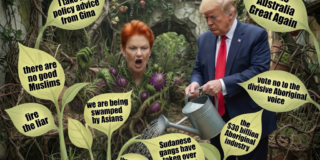
In her 1996 maiden speech to the House of Representatives she said she believed Australia was in danger of being swamped by Asians, who she said had their own culture and religion, formed ghettos and did not assimilate. She added that she would be called racist, and she called for the abolition of multiculturalism. The grammar is worth attention. “Asians” is not a policy, a visa category or an ideology. It is a racial and continental description applied to millions of people with different languages, religions and histories, all of whom are said to behave in the same way. That is the structure of a stereotype, and it is the structure that section 18C and ordinary usage both treat as the core of racial prejudice.
In December 2006 she told AAP that people coming from South Africa had diseases, including AIDS, that they were of no benefit to the country whatsoever, and that they would never be able to work. The context made clear whom she meant: she said that white South Africans were medically tested while black Africans were not, and around the same time she called for a stop to what she described as Sudanese and black South Africans flooding the country. The Immigration Department said she was wrong and that all permanent and temporary entrants undergo health checks. Here the generalisation is explicit and the traits attributed are disease and incapacity. The claim is not about a visa category or a number. It is about what black people as such are like.
In her 2016 first speech in the Senate she updated the 1996 formula. Australia was now in danger of being swamped by Muslims, whose culture and ideology she said were incompatible with ours. She called for an end to Muslim immigration and asked how anyone could tell good Muslims from bad ones. In March 2017, after the London terror attack, she said in an interview that Islam was a disease and that Australians needed to vaccinate themselves against it, and she promoted the hashtag #Pray4MuslimBan. Prime Minister Malcolm Turnbull replied that attributing the crimes of ISIL to all Australian Muslims was doing what ISIL wants. Her defenders say that Islam is a religion, not a race, and that criticism of a belief system is not racial. This is the most serious argument available to them and I return to it below. For now it is enough to observe that the metaphor she chose is not a criticism of a creed. A disease is something people carry in their bodies and something a community is vaccinated against. The vocabulary is of contamination by a population, and a question about whether one can tell good members of a category from bad ones presupposes that the category itself is the problem.
In 2018 she moved a Senate motion acknowledging what she called the deplorable rise of anti-white racism and attacks on Western civilisation, and asserting that it is OK to be white. She said she wanted people of every background, white included, to be able to take pride in their heritage, and she denied any white-supremacist intent. The phrase has been closely associated with far-right online spaces, and the motion was narrowly defeated. I take her at her word that she did not mean to endorse supremacism. But the episode fits a pattern that runs through her career, which is the positioning of white Anglo-Saxon Australians as the group under racial threat. A country whose First Nations people live with a large and well-documented gap in life expectancy is one in which a claim about who most deserves public sympathy is a claim that has to be tested against the evidence, and not merely one organised by race.
In September 2022, on the day Queen Elizabeth II died, she replied to Senator Mehreen Faruqi on social media, telling her to pack her bags and piss off back to Pakistan. That post became the subject of the first judicial finding that she had contravened the Racial Discrimination Act, and I treat it separately below.
The most recent episodes extend the pattern. In a podcast recorded in 2025 and resurfaced in September 2026, she asked what Indigenous Australians had done in this country over what she called supposedly sixty thousand years, said they had never invented the wheel, and described them as the most primitive race on Earth, adding that they had achieved nothing. When the comments resurfaced she first posted the clip with an invitation to the public to judge it, and then offered a qualified expression of regret while maintaining that Indigenous people were primitive compared with the first English settlers. The criticism came from across the political spectrum, including from Indigenous senators across the parliament, and it included a rebuke from Senator Jacinta Nampijinpa Price, a conservative, who pointed out that the words described a race of people.
In February 2026 she asked on Sky News how anyone could say there were good Muslims, and in March the Senate censured her, by 36 votes to 17, for comments its motion described as inflammatory and divisive and seeking to vilify Muslim Australians. In June 2026, in her first address to the National Press Club, she said: “We cannot be a multicultural society. We are a multiracial society, but we must be monocultural.” She called multiculturalism a failed policy and said she would scrap SBS and abolish the Human Rights Commission, the body that receives complaints under the Racial Discrimination Act.
Even by her own definition
The argument so far has been that her definition is the wrong one. The more damaging point is that some of her statements fail even her own test.
Consider again the most recent remark. To say that a people are the most primitive race on Earth is to rank races. It is a claim that races stand at different points on a scale of development and that one of them stands at the bottom. It is hard to see how a speaker who says this can maintain that she has never suggested that any race is inferior, and if one race is the most primitive, it follows from the same ranking that others are more advanced. The claim of superiority is not stated in the words “my race is better”, but it is carried by the structure of the sentence. The defence she offered afterwards, that she was comparing the position at the time of British settlement, concedes the ranking and moves it back in time. It also leaves in place the word “race”, which she herself chose. If her statements are really about culture and not about race, she needed a different noun.
The same difficulty attends the repeated assertion that the problem is culture, not race. A claim that a group of people, defined by origin, cannot or will not assimilate, and that the problem lies in who they are, collapses the distinction between a people and its supposed culture. When an immigrant’s culture is treated as fixed, collective and hereditary, so that every individual is presumed to carry it regardless of what he or she believes or does, culture is functioning as a proxy for descent. Sociologists call this cultural racism, and the question “how can you tell good Muslims from bad ones” is its textbook form.
The Faruqi judgment
The clearest test of the competing definitions came in the case Senator Faruqi brought after Hanson’s 2022 post. In November 2024, in Faruqi v Hanson [2024] FCA 1264, Justice Angus Stewart found that the post breached section 18C. He held that it was reasonably likely to offend, insult, humiliate and intimidate Senator Faruqi and the relevant groups, namely people of colour who are migrants or of recent migrant background, and Muslims who are people of colour, and that it was done because of Faruqi’s race, colour or national or ethnic origin. The phrase “go back to where you came from” was treated as a recognised racist and anti-immigrant trope with a long history, conveying that an immigrant of colour is a second-class member of the community whose presence is conditional. Hanson was ordered to delete the post and to pay costs.
What the court did not do is as instructive as what it did. It did not ask whether Hanson believed that white people were superior to Pakistanis. It asked what the words meant to a reasonable member of the group, what historical meaning the trope carried, and why the post had been written. In reaching its conclusion it also took notice of a pattern of derogatory statements by Hanson about people of colour, migrants and Muslims. That evidence did not need to prove supremacist belief. It was relevant because it bore on why she said what she said.
Hanson appealed, arguing among other things that section 18C should not apply to political communication because the Constitution protects it. On 27 July 2026 the Full Court of the Federal Court unanimously dismissed the appeal, holding that none of the grounds had been established, agreeing that the post was directed at immigrants, people of colour and Muslims, and finding that it had no genuine connection to the issues raised by Faruqi’s own post. Hanson has said she will consider an appeal to the High Court. Two things follow. First, the clearest judicial test of whether her words are racial discrimination in the legal sense has been run twice, with the same result. Second, she has lost on both the statutory question and the constitutional one at the level of the Full Court, and the only live question is whether the High Court will take a different view.
Why section 18C matters to her
A common claim is that the repeal campaign exists so that she can make racist comments without fear of breaking the law. The record supports part of that claim and stops short of the rest.
It supports the claim that she has long campaigned for repeal or narrowing of the provision, that she has now litigated against it to the Full Court, and that she has done so after a judge found one of her public statements to breach it. In the costs decision that followed the trial, Justice Stewart observed that her constitutional challenge was important to her because it was aimed at ensuring that she and others could continue to say the sorts of things he had found unlawful. That is a judicial characterisation of the purpose of her litigation, and it is the strongest textual support for the argument. In her Press Club speech she went further and said she would abolish the Human Rights Commission, which administers the complaints process. On the critics’ reading, a person who says her statements are not racist has no practical need for a law against racist statements to be removed, and the energy she now invests in removing it suggests that she knows her statements are at risk.
What the record does not do is establish her subjective motive. She would say that the campaign is a principled stand about the limits of state regulation of political speech, a view that many Australians who do not support One Nation also hold, and that she argued the point long before she was the respondent in a case. A fair essay can say that the timing of her litigation, the breadth of what she says she wants to be free to say and the pattern of the statements make the critics’ inference a strong one. It cannot say that the inference is proved.
What her defenders would say
A serious reply from her side would make at least four points, and they deserve to be stated fairly.
The first is that Islam is a religion and a set of ideas, and that religion is not a protected attribute under the Racial Discrimination Act. On this view, criticism of Islam, even harsh criticism, is not racial, and treating it as racial both silences legitimate debate and treats all Muslims as members of a single ethnicity, which is itself a kind of stereotype. This argument has real force, and the Federal Court did not hold that criticism of a religion is as such unlawful. The difficulty for Hanson is that her statements are rarely confined to doctrine. They concern Muslims as people, their numbers, their immigration and whether any of them can be trusted, and the Faruqi judgment was concerned with the way religion and race intersect in a person of colour who is also Muslim. Her defenders can also point out that the Australian Federal Police examined her “good Muslims” remark after complaints and concluded that it did not meet the threshold for the relevant criminal offences, and that she later said she believed some Muslims were good. That is a different and much higher test than section 18C, but it is part of the record.
The second is that section 18C is too broad. The words “offend” and “insult” set a low-sounding threshold, and critics from across the political spectrum have argued that they chill legitimate debate, a concern that was prominent in the Bolt litigation and in the parliamentary debates over amendment. The courts have answered that the provision reaches only conduct with profound and serious effects and that section 18D provides a broad exemption, but the argument that the statute should be narrowed, for example by replacing “offend” and “insult” with a harassment standard, is one that thoughtful people hold without any sympathy for her views. A person can oppose section 18C without being a racist, and it would be wrong to treat opposition to the provision as itself proof of anything about the opponent. My argument is that her particular record, and not the position she takes on the statute, supports the conclusion that she is racist.
The third is that a legal finding about one act is not a finding about a person. Justice Stewart decided that a post breached the Act. He did not hold that Hanson is, in her heart, a racist, and the distinction between saying racist things and being a racist is one that moral philosophers and lawyers both take seriously. That is correct, and I accept it as a limit on what the case proves. My response is that the question this essay addresses is whether she has said racist things, and that a long and varied record of such statements, the latest as recent as this year, is as good evidence of character as public life usually provides.
The fourth is that she has apologised, however conditionally, and that her supporters regard the repeated pile-on as a political attack on a politician who speaks for voters the major parties ignore. Barnaby Joyce has said her character is a ten out of ten, and polling suggests that her support has not been hurt by the controversy. Popularity, however, is not a defence to a charge of racism, and the qualified form of her apologies, which regret offence but retain the underlying claim, is part of what critics rely on. Her supporters would add that in the same Press Club speech she said her vision was that all Australians are equal regardless of race, colour or creed, and that she later pointed to the Socceroos as her model of a team of varied backgrounds united under one set of rules. On that reading, monoculture is a demand for shared laws, language and loyalty, not for racial uniformity.
The words are in the record
Hanson’s definition of racism is not wrong because it is unusual. It is wrong because it is constructed so that only an open confession of supremacy could ever fall within it, and because it ignores the two things that every serious account of racism asks about: what the words do and what they are done because of. Under section 18C, and under the international convention behind it, a statement is racially discriminatory if it targets people because of race, colour or national or ethnic origin and is reasonably likely to seriously offend, insult, humiliate or intimidate them. Two courts have held that her best-known recent post meets that test. Under the ordinary meaning of the word, her generalisations about Asians, black South Africans, Muslims and Indigenous Australians fit the pattern of attributing collective negative traits to people because of their origin. And under her own definition, the statement that one race is the most primitive on Earth is difficult to read as anything other than a ranking.
The gap between her definition and the law is therefore not a technical quarrel. It is the gap in which her public career has been conducted. Whether the High Court will be asked to narrow the law that exposed her is a question for the court. The question the evidence has already answered is the one she posed. She has asked for years to be shown what she said. The words are in the record.
– – –
Bakchos is the founder of Blak and Black, an Australian media and advocacy platform established in 2010. Bakchos writes from the intersecting perspectives of Wiradjuri heritage, Jewish identity, and humanism.
© Bakchos, October 2026