
Albert Barume, the Locked Doors, and the Children of the Territory
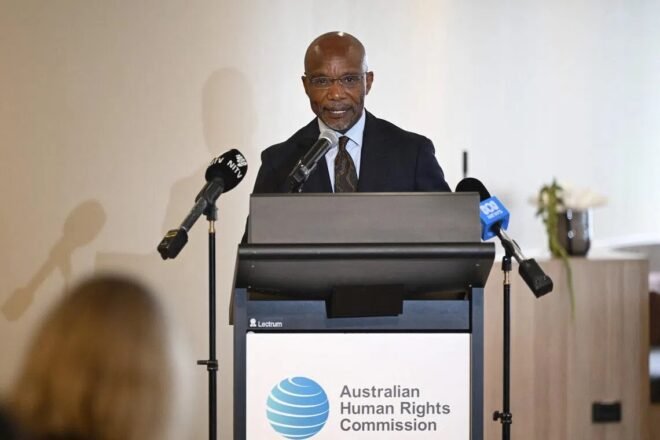
At the close of his visit to Australia in mid-November 2026, the United Nations Special Rapporteur on the rights of Indigenous Peoples stood at a lectern bearing the logo of the Australian Human Rights Commission and said something that governments seldom hear from an official guest. Dr Albert Barume, a jurist from the Democratic Republic of Congo, described the continuing detention of Aboriginal and Torres Strait Islander children as a generational failure and a new stolen generation. The state of protection of Indigenous people’s rights in this country, he told reporters, was “really embarrassing.” He said this having been refused entry to two of the places he most wanted to see: the Holtze youth detention centre outside Darwin and the Cleveland youth detention centre in Queensland.
The Koori Mail’s report of his remarks, set beside a companion piece on the Northern Territory’s prison record, repays careful reading, because between them they raise four questions that Australia has been avoiding for a long time. Why were the doors closed to him? What do the numbers say, and how far can we trust them? Who is actually responsible for a system of youth justice in a federation that signs treaties in Canberra and runs prisons in the states and territories? And what would it mean to take seriously the proposition that locking up children is failing even on its own terms? I want to take each in turn, and to give the strongest version of the opposing arguments as I go, because a case that cannot survive its best critics is not worth making.
The Doors That Stayed Shut
A visit by a Special Rapporteur rests on a simple bargain. A state extends an invitation, as Australia did when it issued a standing invitation to all the UN’s independent human rights experts in 2008, and in return the expert is permitted to see the country as it is rather than as it is described. Seeing is the whole of the method. A rapporteur who can only read submissions and meet advocates is a reporter without a camera. Holtze and Cleveland are not peripheral institutions. They are the places where the question of what Australia does with its children is answered in concrete and steel, and a refusal of entry says something that no briefing paper could.
Nor is the pattern new. In 2022 the United Nations Subcommittee on Prevention of Torture cancelled its visit to Australia after being denied access to prisons in Queensland and New South Wales. Australia had ratified the Optional Protocol to the Convention against Torture in 2017, and the entire premise of that instrument is unannounced, independent access to places of detention. The domestic inspection bodies the Protocol requires have been widely criticised as slow and uneven in coming, which is a quiet way of saying that the country accepted the obligation and then delayed the machinery. When a federal government signs a treaty and the state governments then decline to honour the access it promises, the signature begins to look like a courtesy rather than a commitment.
The history of Australian detention should make us wary of closed doors. The Royal Commission into Aboriginal Deaths in Custody reported in 1991 that secrecy and isolation were conditions in which neglect flourished. A quarter of a century later, the abuse of boys at the Don Dale centre in Darwin, including a child in a spit hood strapped to a restraint chair, came to national attention not through any inspection regime but because a television program obtained the footage. The Royal Commission that followed found a system that had normalised conduct no one outside it would have accepted. Institutions that hold children out of public view are not neutral spaces. They tend, without constant light, toward their own convenience.
There are reasons a government might offer for restricting access, and they are not frivolous. Detained children are minors, and their privacy matters. Staff safety is a genuine operational concern, and a centre in a volatile period cannot be treated as a tourist site. But these are answers to the question of how access should be arranged, not whether it should be granted. A visitor can be bound by confidentiality, can be accompanied, can be scheduled around an incident. What a government cannot reasonably do is invite the world’s independent expert on Indigenous rights and then close the very doors that would let him assess the thing he was invited to assess. The refusal leaves the public to draw the obvious inference, whether or not it is the right one.
The Arithmetic of Over-Representation
The figures in the Koori Mail are stark enough to need little commentary. A Senate report in September found that on an average night in the June 2025 quarter, 60 per cent of the children detained in Australia were Indigenous, although First Nations young people make up about 6.6 per cent of Australians aged 10 to 17 (the article describes this as a share of the general population, whose Indigenous proportion is closer to 3.8 per cent). The Australian Institute of Health and Welfare’s own rate ratio for that quarter is 21: First Nations young people aged 10 to 17 were 21 times as likely as their non-Indigenous peers to be in detention. The figure of 24 times quoted in some secondary reporting does not match that series, so I have used the official one. Among those aged 14 to 17, almost four in five First Nations young people in detention were unsentenced, held on remand rather than serving a sentence. Dr Barume said that in certain prisons the share of Indigenous inmates reaches 90 per cent, with some of those held as young as ten.
The Northern Territory is the extreme case. The companion article, written from the Federal Minister for Indigenous Australians’ perspective, reports that the Territory imprisons 1,380 people for every 100,000 adults, against a national average of 228, that it now holds almost 2,900 inmates, and that it has done more per capita than almost any jurisdiction in the world since the Country Liberal Party took office, second only to El Salvador. A private prison costing more than a billion dollars is on its way to accommodate the swelling population. Conditions have already been condemned as inhumane by the then acting Territory ombudsman, Bronwyn Haack. Elsewhere the news is not much better: imprisonment rates have risen across most jurisdictions since 2019, and Victoria is described as the only state with a clear fall.
A word of caution belongs here, because evidentiary discipline is what separates advocacy that persuades from advocacy that merely agrees with itself. The article reports a Territory increase of 1,609 prisoners per 100,000 adults over six years, a figure larger than the 1,380 overall rate quoted in the companion piece. Both may be correct, since one may describe the Indigenous rate and the other the whole population, or one may be a count of prisoners rather than a rate, but they cannot be placed side by side without explanation. Anyone quoting these numbers should return to the Australian Bureau of Statistics and the Senate report and confirm the base each one uses. The comparison with El Salvador, similarly, should be handled with care: that country’s mass incarceration has taken place under a prolonged state of exception that is itself the subject of serious human rights criticism, so the comparison is a measure of scale, not a claim that conditions are identical. None of this softens the underlying picture. Whichever way the numbers are reconciled, a first-world democracy is locking up its Indigenous children at a rate that would be a national scandal if applied to any other group.
A New Stolen Generation
The phrase Dr Barume chose, a new stolen generation, is not hyperbole, and its force comes from the document that gave the original its name. The Bringing Them Home report [AEB1] of 1997 documented the removal of Aboriginal children from their families under policies of protection and assimilation, and recorded the lifelong consequences: broken kinship, lost language, trauma that passed to the children of those removed. The inquiry’s most painful finding was that those who did the removing believed, for the most part, that they were doing good. A policy that damages a people can be administered by sincere officials, which is exactly why sincerity is never a defence.
The parallel today is structural rather than literal. No one is now sent a letter stating that a child will be taken to be made white. Instead there is a conveyor belt of ordinary decisions: a school suspension, a charge for a first minor offence, a refusal of bail because the child has no stable address, a remand in custody, a period in a facility hundreds of kilometres from home. At the end of the belt stands a child who has been separated from family and country for the second or third time, and whose chance of an adult criminal record has risen sharply. Dr Barume made the link explicit when he said that Indigenous youth cannot continue to populate the prisons, and cannot continue to populate the majority of the care system, because it is killing the coming generation.
The cruelty is sharpest at the very beginning of life. He was, the report says, particularly shocked by recent accounts of Indigenous mothers being shackled during birth. International standards on this point are not ambiguous. The UN Standard Minimum Rules for the Treatment of Prisoners, known as the Nelson Mandela Rules, prohibit instruments of restraint on women during labour, during birth and immediately afterwards, and the Bangkok Rules say much the same. That such practices are being reported in a wealthy country that regards itself as a defender of the rules-based order is not a matter of resources. It is a matter of whose bodies are treated as threats, and the answer, once again, is not hard to find.
Whose Responsibility? The Federation and Its Alibi
The most consequential claim in the article is a legal one. Dr Barume said the federal government was duty-bound to institute a national, minimum mandatory standard for youth justice, and that Indigenous people’s rights are unsafe in the hands of states and territories. The federal minister’s own contribution to the same pages takes a different view: responsibility for the justice system, she writes, sits squarely with the Northern Territory government, whose policy of mass incarceration and a private prison will have a devastating intergenerational impact.
Both statements contain truth, and the tension between them is the story. Under the Constitution, criminal justice is chiefly a matter for the states and territories, and a Commonwealth that legislated broadly into that field would be accused, not unreasonably, of centralising power and overriding local democratic judgement. That is the steelman of the federal reluctance, and it carries real weight in a country that cherishes its federal arrangements. But international law does not recognise the division of powers inside a state as an excuse. Article 50 of the International Covenant on Civil and Political Rights provides that its provisions extend to all parts of federal states without any limitations or exceptions, and the Convention on the Rights of the Child, which requires detention to be a measure of last resort and for the shortest appropriate time, binds Australia as a whole. Canberra signs; the states perform; and when they do not, Canberra points at them.
There are, moreover, levers the Commonwealth has used when it wished to. The Northern Territory is not a state. It governs itself under a Commonwealth statute, and Parliament has overridden its laws before, most notoriously when it nullified the Territory’s euthanasia legislation in 1997 and again in 2007 when the Northern Territory Emergency Response suspended the operation of the Racial Discrimination Act. I raise those precedents not because the second was a model of good policy, which it was not, but to show that the objection that Canberra cannot intervene in the Territory is a political position rather than a constitutional fact. The Commonwealth also holds the purse. The agreement the minister describes, which will direct $80 million under the Northern Territory Remote Aboriginal Investment Agreement to community-controlled organisations, shows that funding can be shaped toward evidence-based alternatives. A national minimum standard could be built the same way, as a condition of the grants that already flow.
The content of such a standard is not mysterious. The age of criminal responsibility should be at least fourteen, which the medical and developmental evidence supports and which the Territory reversed itself in 2024 by returning to ten, while the ACT has legislated to lift it to fourteen. Detention should be a last resort in practice rather than only in text. Independent inspectors should have unannounced access, which would have rendered the refusal at Holtze and Cleveland impossible. And restraints on women in labour should be prohibited outright. None of these requires a constitutional referendum. They require a government prepared to be a little unpopular.
The Case for Locking People Up, Fairly Stated
It would be dishonest to write about this subject without acknowledging the arguments on the other side, because they are held by decent people. The first is that communities, including Aboriginal communities, suffer enormously from crime. Break-ins, assaults and car theft in Alice Springs, Townsville and elsewhere are not abstractions, and the victims are very often First Nations families themselves. A political class that dismissed their fear would deserve the contempt it received. The second is that detention does incapacitate: a young person in custody is not committing offences on the street, and for the small group of serious repeat offenders that is not nothing. The federal minister concedes the point directly, writing that no one objects to violent criminals being locked up.
The data on victimisation is what turns the community-safety argument from rhetoric into fact. Most First Nations people do not commit violence or crime, but First Nations people are over-represented as both perpetrators and victims. The Australian Institute of Health and Welfare reports that in 2024–25 First Nations people were about fourteen times as likely as non-Indigenous Australians to be hospitalised for assault, that First Nations women were roughly thirty times as likely to be hospitalised for family violence-related assault, and that the homicide death rate was about seven times the non-Indigenous rate. In the jurisdictions with published data for 2023, most First Nations victims of assault knew their offender, and family and domestic violence accounted for between two-thirds and four-fifths of assaults on First Nations victims. These are not abstractions about “the community.” They describe who is most often hurt: Aboriginal women, children and elders, in the same towns where the youth offending that dominates the news takes place. A parent in Alice Springs who wants an offender off her street is, very often, an Aboriginal parent, and a policy debate that treats her fear as illegitimate has misunderstood what it is dealing with.
The honest conclusion is not that detention should be abolished but that the case against mass detention has to be made on the victims’ terms. A child held for a few weeks is, for those weeks, not breaking into houses, and a community enduring a run of offences may reasonably want relief now rather than a justice reinvestment program that pays off in three years. Reform therefore has to deliver something in the short term: bail support and supervised accommodation, so that children are not remanded simply because they have nowhere safe to go; rapid, intensive intervention for the small number of serious repeat offenders; and community safety measures, such as night patrols, funded in the same budget as any new facility. A reform program that asks a frightened community to wait for the evidence will lose the argument, and will deserve to.
The question is not whether some young people need to be held but whether mass detention produces the safety it promises. Here the evidence the minister cites points the other way. She argues that the Territory’s approach amounts to locking people up first and dealing with the consequences later, and that a cohort cycling through a system built on that logic will not leave Territorians safer. The mechanism is well understood by criminologists: custody disrupts schooling, severs positive relationships, concentrates young people with others who offend, and leaves them with a record that narrows their prospects. A policy that increases the number of people with every reason to offend again is working against its own purpose, and the largest prison the Territory has ever built will not change that.
The counter-evidence in the article comes from Groote Eylandt, where community-led justice initiatives, including a Community Justice Group and a Community Court, are credited with a dramatic reduction in offending. The Anindilyakwa Land Council reports that recorded offences fell from 1,041 in 2019 to just 130 in the year to mid-2025, and that youth offences fell from 267 to 28. These figures come from the body that runs the program, and a prudent reader will want independent evaluation before treating them as definitive; recorded offences can also fall for reasons unrelated to any program. But they are consistent with a body of research, including studies of justice reinvestment in places like Bourke, which suggests that when communities are given authority and resources to address the causes of offending, they often do better than any distant institution. The principle behind them is not soft. It is the observation that people closest to a problem usually understand it best, and that a prison, which is the most expensive tool available, ought to be the last one reached for rather than the first.
The Voice, the Vote and the Reputation of a Country
Dr Barume linked the crisis in youth justice to the outcome of the 2023 referendum. The overwhelming No vote, roughly 60 per cent nationally, was in his words a force that unleashed “the floodgates of racism and bigotry,” and he said Indigenous people are not sure the gains they have made will survive the next federal election. This is a strong claim, and it needs to be handled with the same care as the statistics. Many Australians voted No for reasons that had nothing to do with prejudice: doubts about the drafting, the process, the precedent of a body in the Constitution, or simple unfamiliarity. It would be unfair, and politically self-defeating, to read every No as a verdict on First Nations people. What can be said without exaggeration is that the referendum removed the one proposed channel through which Indigenous communities might have been heard on matters like youth justice before decisions were made, and that the public conversation that followed was, in places, ugly.
His practical proposal, which does not depend on the referendum’s interpretation at all, is a national political body that represents First Nations people, which he calls a building block in stemming the incarceration crisis. The logic is hard to dispute. Closing the Gap, the Royal Commission recommendations and the minister’s own account of Groote Eylandt all point in the same direction: outcomes improve when Indigenous people hold decision-making power. The Uluru Statement from the Heart, issued in 2017, said that Indigenous youth languish in detention in obscene numbers and asked for a structure through which communities could speak. The country has now had nearly a decade to consider that request, and the detention numbers have continued to climb.
There is also a question of national self-image. Dr Barume was scathing about the Prime Minister, urging Anthony Albanese to show leadership globally, particularly as Canberra seeks a seat on the UN Security Council. A country that asks the world to elect it to the body responsible for international peace and security, while refusing a UN rapporteur access to its youth prisons and shackling women in labour, invites an obvious question about consistency. “It’s just really hurting their reputation,” he said, “because this is below international standards.” Reputation is easy to dismiss as vanity, but in diplomacy it is a form of credit, and every instance of a government telling other states to meet standards it does not itself meet draws down on that account.
What Taking It Seriously Would Mean
Dr Barume will report to the UN Human Rights Council in September 2027, and the world will then read, in measured diplomatic language, what he concluded. It is worth reflecting on what Australia would want that report to say, and what it would take for it to say something different. The easy response is the one governments have given for decades: to acknowledge the concern, point to the complexity of federalism, announce a review, and wait for the news cycle to move on. The history of this subject is a history of reports gathering dust, from the Royal Commission into Aboriginal Deaths in Custody to Bringing Them Home to the Don Dale inquiry. The recommendations were there. The will was not.
The harder response is to treat the rapporteur’s visit as a test the country can still pass. That would mean opening every youth detention centre to independent, unannounced inspection and publishing the results. It would mean a national minimum standard for youth justice, with an age of criminal responsibility of at least fourteen and detention as a genuine last resort. It would mean ending the shackling of women in labour, by statute rather than by policy, since policy is what has failed. It would mean directing funding toward community-led alternatives and evaluating them honestly, both the successes and the failures. And it would mean a seat at the table, permanent and respected, for the people whose children are being counted in these statistics.
A sceptic will say that such reforms cost money and political capital, and that voters have little patience for leniency toward young offenders. That is true as far as it goes. But the status quo is not cheap. It costs a billion dollars for a single prison in the Territory, it costs the productive lives of the children it consumes, and it costs the public the safety it claims to protect. The arithmetic of mass incarceration has never worked, and it will not start working because the prison is new.
What the Koori Mail’s pages show, in the end, is a country in which a visitor from the Congo, a land that knows something of what states can do to their people, has found the treatment of Indigenous children so far below the standard he expected that he used the word embarrassing. It is a word that should land hard. Embarrassment, properly felt, is the beginning of shame, and shame, properly directed, is the beginning of change. The doors at Holtze and Cleveland were closed to one man in November 2026. The test of whether Australia means what it says is whether they are opened, for every inspector, every advocate and every family, long before September 2027 arrives.
Sources and notes.
Quotations and the Northern Territory figures are taken from the Koori Mail of 18 November 2026 (an AAP report on Dr Barume’s visit and a companion column by the federal minister for Indigenous Australians). Youth detention rate ratios and the share of detainees on remand are from the Australian Institute of Health and Welfare, Youth detention population in Australia 2025. Victimisation figures are from AIHW injury and community safety reporting and the Indigenous Health Performance Framework. The 1,380 and 1,609 Northern Territory figures should be checked against the primary ABS series before they are quoted elsewhere.
– – –
Bakchos is the founder of Blak and Black, an Australian media and advocacy platform established in 2010. Bakchos writes from the intersecting perspectives of Wiradjuri heritage, Jewish identity, and humanism.
© Bakchos, November 2026