
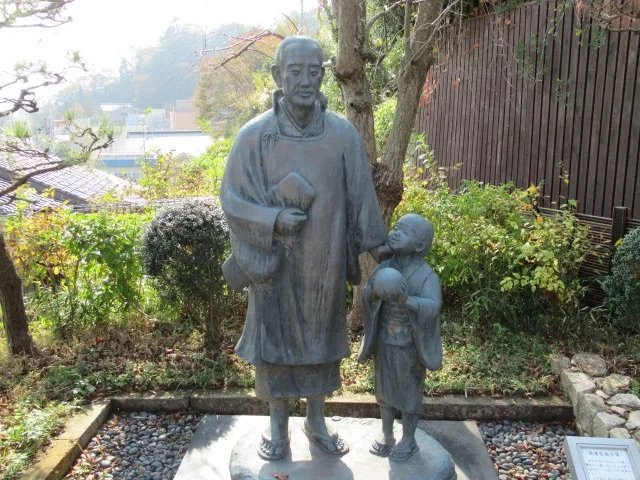
Tachibana Akemi and the Art of Delight
A late-Edo poet gave away his inheritance, declined a lord’s offer of a post, and spent his life counting the small joys most of us walk past. His poems make a quiet argument: that attention is a form of wealth, and that a good life can be rich in almost everything that matters while poor in nearly everything that is counted.
There is a kind of greatness that announces itself with monuments, campaigns, and the roar of crowds, and there is another kind that sits quietly in a small house, watches the morning come, and writes down what it feels. Tachibana Akemi, who lived from 1812 until October of 1868 in the Echizen province of Japan, belongs to the second kind. He commanded no armies and held no office. He lived in a house he called Waraya, the straw hut, and from that modest place he made some of the most luminous poems of the late Edo period. His work is a standing argument, made gently and without a trace of sermonising, that a human life can be rich in almost every way that matters while being poor in nearly every way that is counted.
Given and Given Away
Consider first what he was given and what he did with it. He was born in Fukui, the son of a merchant who dealt in paper, ink and related goods, which is to say that he came from a household of some comfort and some literacy. Loss arrived early. His mother died when he was about two, and his father when he was about fifteen. A boy might have been hardened by this, or made grasping, or made afraid. Akemi was made attentive. He tried the path of a Nichiren Buddhist priest for a time, studied the Chinese classics in Kyoto, married a woman named Naoko around the age of twenty-one, and then, in his late twenties, did something that still startles. He handed the family business and inheritance to a half-brother and walked out of the life that had been prepared for him. He chose to become a recluse and a student of poetry and the ancient texts. There is no bitterness in this story. A man who gives away his security in order to give his full attention to what he loves is making the most generous trade available to him, and Akemi made it with open eyes.
Clean Poverty
The life that followed, first at a place he called Koganenoya on Mount Asuwa and then, from around the age of thirty-seven, at the straw hut in Mitsuhashi, is often described as poverty, and it was. But Japanese readers have long used a more careful phrase for it: seihin, clean poverty. The word is the key to everything. Clean poverty is not the poverty of the beggar who has been crushed, nor of the miser who hoards. It is poverty chosen and kept with dignity, a way of stripping a life down until nothing stands between the person and the plain goodness of being alive. Akemi was supported by disciples and by occasional teaching, and he lived on little. Yet when the lord of Fukui, Matsudaira Shungaku, came to visit him and offered a position and a stipend, Akemi declined the post. The man who could have had a place at the centre of the domain’s cultural life preferred his hut and his books and his freedom, and he did so without scorn for the lord who honoured him. That refusal is one of the quiet glories of the period. It shows a person who knew precisely what he valued and could not be bought out of it, and who stayed gracious while saying no.
The Scholar in the Hut
Behind the poet stood a serious scholar. In 1844 he became a student of Tanaka Ōhide in Takayama, in Hida Province, a scholar of the kokugaku, the national learning movement, and a direct disciple of the great Motoori Norinaga. Akemi never studied under Norinaga himself, who had died in 1801, but he admired Norinaga’s scholarship and his style deeply, and through Ōhide he entered that lineage of careful, loving attention to the classical Japanese tradition. He read in the spirit of the Man’yōshū, the oldest and in many ways the most vigorous of Japan’s great poetic anthologies, where feeling is spoken plainly and the heart is not dressed up before it is shown. This is the proper setting for his gift. Akemi was no naive rustic stumbling onto simplicity. He was a learned man who understood the tradition well enough to know which of its qualities were worth carrying forward, and he chose directness, warmth, and truth to life.
Fifty-Two Pleasures
That choice produced his masterpiece. The Dokurakugin, usually rendered as “Reciting Poetry for My Own Pleasure” or “Solitary Pleasures,” is a sequence of fifty-two tanka, each opening with the same phrase: tanoshimi wa, “it is a pleasure when.” The repetition is the whole genius of the form. Each poem takes that same doorway and walks through it into a different small room of ordinary happiness. The most famous of them is the poem of the flower:
たのしみは朝おきいでて昨日まで無かりし花の咲けるを見る時
It is a pleasure when, rising in the morning, I go outside and find a flower that has bloomed that was not there yesterday. Nothing in this poem is rare.
There is no distant mountain, no dramatic moon, no heartbreak. There is a man, a morning, a doorstep, and a flower that was a bud the day before. And yet the poem turns the reader’s attention toward the thing most of us walk past every day: that the world renews itself overnight, quietly, for free, and that noticing it is a form of wealth no one can tax or take. When President Bill Clinton quoted this poem in 1994 at a White House welcome for Emperor Akihito and Empress Michiko, he was doing something rather lovely. He was reaching across an ocean and a century and a half to borrow a poor man’s joy for the occasion of a state visit, and it fit perfectly, because the poem belongs to everyone.
The Treasures of a Small House
The other poems in the sequence are just as warm, and reading them together shows how much of a life he managed to fit inside that single refrain. Some of them look inward, to the stillness of the hut itself:
たのしみは草の庵の筵敷きひとりこころを静めをる時
It is a pleasure when I spread a mat in my grass hut and sit alone, letting my heart grow quiet.
This is solitude without any trace of loneliness. The hut is not a place where he has been left; it is a place he has chosen, and the quiet is something he lays out as carefully as the mat.
Others turn outward to the household, where his happiness is bound up with the happiness of the people he loves:
たのしみはまれに魚煮て児等皆がうましうましといひて食ふ時
It is a pleasure when, now and then, I have cooked a fish and all the children say “delicious, delicious” as they eat.
The word rare in that line tells us everything about the family’s circumstances, and the doubled umashi, umashi tells us everything about their joy. A father who has little can still be, for the length of a meal, the author of a feast. A companion poem, on the same note, finds the pleasure in a wife and children gathered close, heads together, eating side by side.
His love of learning, which sits at the centre of his life, appears just as naturally:
たのしみは珍しき書人にかり始め一ひら広げたる時
It is a pleasure when I have borrowed a rare book from someone and open the first page.
A man who could not afford to buy such books felt the thrill of borrowing them, and there is generosity in the poem as well, because it quietly honours the friend who lent it. A second poem goes deeper, into what reading is for:
たのしみはそぞろ読みゆく書の中に我と同じ心の人にあひたる時
It is a pleasure when, reading idly through a book, I meet a person whose heart is the same as mine.
Here the lonely scholar in his straw hut breaks through the walls of time and place. The author of the book may have lived centuries before, yet he sits beside him for a moment, and that meeting is counted among the greatest joys of his life.
And then there is the poem that shows his humour and his honesty about money, which no portrait of him should leave out:
たのしみは銭なくなりてわびをるに人の来りて銭くれし時
It is a pleasure when my money has run out and I am sitting there in distress, and someone comes and gives me money.
There is no pretence in this at all. The poet of clean poverty admits, with a smile, that he sometimes ran short and that rescue felt wonderful. The poverty he chose was never an affectation, and the poems are better for being willing to say so. Taken together, they form something like a portrait of a whole existence: the quiet mat, the shared fish, the borrowed book, the kindred spirit on the page, the unexpected kindness at the moment of need. Here is a man who has almost nothing, and he is listing his treasures, and the list is longer than a rich man’s. The household, the children’s voices, the table, the book, the flower: these are the real estate of a contented heart. What makes the poems powerful, rather than merely pleasant, is their quiet defiance. They refuse the idea that happiness is something deferred until circumstances improve. Akemi finds it now, in the room he is in, with the people beside him.
A Wider Range
His range was wider than this, which is part of his stature. He wrote on household details, on work and labour, on the simple comforts of a hard life, and at times on political and national themes, as befitted a scholar of the national learning in an age when the country was uneasy. He wrote travel accounts, including a record of a visit to Ise Shrine, and essays and further verse. His main poetry collection, the Shinobunoya kashū, was compiled by his son and published in 1878, a decade after his death, and it holds hundreds of tanka in the same plain, direct, affectionate voice. That a son gathered and preserved his father’s poems is itself a small testimony to the household Akemi built in that straw hut. The children who ate the rare fish and called it delicious grew up to treasure what their father made.
Recognition
Akemi died on the twenty-eighth day of the eighth month of Keiō 4, which is 13 October 1868, shortly before the Meiji Restoration swept the old order away. He did not see the new Japan, with its railways and its reforms. In his lifetime his reputation hardly travelled beyond Echizen. Then, in 1899, the great modernising poet Masaoka Shiki published a newspaper article praising him as one of the finest poets since the Man’yōshū and Minamoto no Sanetomo. It was an extraordinary act of recognition, and it changed everything. A poet whom the world had almost missed was set in the front rank of the tradition by one of the sharpest critical minds of the age, and the later tanka poets of modern Japan learned from him. Today his grave lies at Daian-zenji Temple in Fukui, and a memorial literature museum stands on the site of his old residence, so that visitors may stand where the straw hut once stood and look at the same sky.
What He Leaves Us
What, finally, should we take from him? Not poverty itself, which is no virtue when it is imposed and no prize when it is endured without choice. What we should take is the example of a person who decided what was enough, and then gave himself completely to enjoying it. Akemi teaches that attention is the most valuable currency a human being possesses, and that it can be spent on the smallest things with the largest returns. He teaches that integrity can be quiet, that a refusal can be courteous, and that scholarship and simplicity are not opposites but partners. In an age that tells us constantly what we lack, he sits in his hut and reminds us what we already have: a morning, a doorway, a flower that opened overnight, and someone to share the fish with. That is a great deal. He saw it clearly, and he wrote it down so that we could see it too.
Notes:
The wording of poems from this period varies between sources.
The English renderings of them are mine.
– – –
Bakchos is the founder of Blak and Black, an Australian media and advocacy platform established in 2010. Bakchos writes from the intersecting perspectives of Wiradjuri heritage, Jewish identity, and humanism.
© Bakchos, November 2026




Some of the richest lives are lived in small houses.
.
Tachibana Akemi, a poet from Fukui in late Edo Japan, gave away his inheritance, declined a lord’s offer of a post, and made his home in a straw hut. There he wrote fifty-two poems that each begin “It is a pleasure when…”: finding a flower that was not there yesterday, opening a borrowed book, hearing the children call a rare fish delicious.
A father who has little can still be, for the length of a meal, the author of a feast.
I didn’t know that you knew Japanese, I wonder if all of those in Canberra who continually lie about you, know the true depth of who you really are?