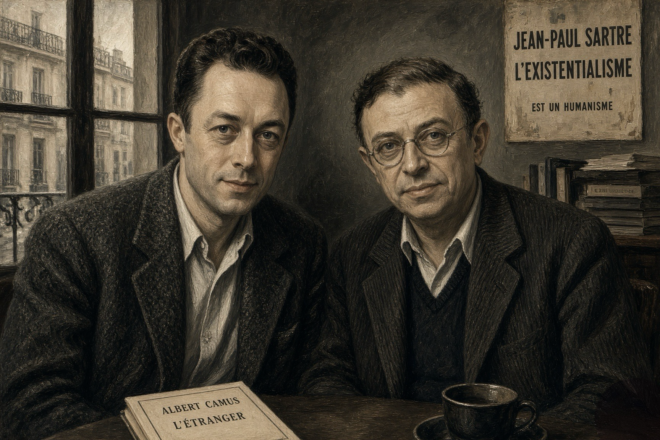
Two writers, one empty sky, and the choice between lucid endurance and radical self-creation.
There is a particular silence that modern philosophy has had to learn to hear. For most of human history, the questions of why we are here, what we owe one another and how we ought to live were answered, or at least addressed, by a cosmos assumed to be listening. Gods, providence, natural law and the order of the heavens all supplied a ground beneath human projects. When that ground gave way in Europe, the result was not simply a loss of belief but a loss of orientation. Albert Camus and Jean-Paul Sartre, two writers who came of age amid the wreckage of the interwar years and the Occupation of France, are the thinkers who most memorably mapped what followed. Both accepted that the universe offers no inherent purpose. Yet from that shared starting point they walked in different directions, and the distance between them tells us a great deal about the choices still open to anyone who has stopped expecting the world to explain itself.
The Silence of the World
Camus begins with a tension rather than a doctrine. In Le Mythe de Sisyphe (1942) he argues that the absurd is neither a property of the world nor a feature of the human mind taken separately. It is born, he says, from the confrontation between the human appeal for clarity and the unreasonable silence of the world. A person who asked for nothing would never feel the absurd, and neither would a universe that answered. What produces it is the meeting of two things that cannot be reconciled: a creature that insists on reasons and a reality that declines to supply them. This is why Camus resists the temptation to treat the absurd as a problem to be solved. A solution would dissolve one side of the relation, and the absurd would vanish along with the honesty that gave rise to it.
That resistance explains the notorious opening of the essay, which declares that the one truly serious philosophical problem is whether life is worth living. Camus asks the question seriously because he thinks the absurd, once recognised, tempts us toward two kinds of escape. The first is literal suicide, which ends the tension by ending the person who feels it. The second, which he calls philosophical suicide, is subtler and in his view just as much an evasion. It is the leap that thinkers such as Kierkegaard, Jaspers and Chestov made, in different ways, when they confronted the failure of reason and then affirmed a transcendent meaning precisely because it could not be rationally grasped. Camus respects the honesty of their diagnosis and rejects the cure. To leap is to pretend that the silence has been broken, when all that has happened is that the questioner has agreed to stop asking. The only integrity available, he insists, is to hold both terms together: to go on demanding meaning while acknowledging that none will arrive.
Revolt, Freedom and Passion
Out of this stance Camus draws three consequences, which he names revolt, freedom and passion. Revolt is the refusal to be reconciled, the daily renewal of the confrontation. Freedom is the release that comes once one has given up on an ultimate purpose that would dictate how to live. The absurd person is free from the demand to justify existence by appeal to some final end, and therefore free to live intensely, in the present, and for its own sake. Passion is the quantity of experience rather than its supposed quality: not the pursuit of a particular goal but the refusal to squander the only life there is. The figure who embodies all this is Sisyphus, condemned by the gods to roll a boulder up a hill only to watch it fall back, forever. Camus does not soften the sentence. The labour is pointless and will never be completed. But he turns attention to the moment when Sisyphus descends the hill to begin again, fully conscious of his fate. In that lucid walk, Camus argues, the punishment loses its power, because scorn and awareness have made the rock his own. One must imagine Sisyphus happy, he concludes. The line is easily misread as consolation. It is closer to a claim about the dignity of a mind that has stopped waiting to be rescued.
The Root of the Chestnut Tree
Sartre arrives at the same emptiness by a different route, and he draws from it a more demanding programme. His novel La Nausée (1938) stages the discovery of contingency as a bodily experience. Antoine Roquentin, sitting in a park and staring at the root of a chestnut tree, suddenly perceives that the root has no reason to be there. Nothing explains it, nothing justifies it, and nothing required it. Everything that exists is, as Roquentin comes to see it, born without reason, prolonged by weakness and killed by chance. The categories that normally make the world feel orderly, such as names, functions and explanations, are revealed as a thin layer laid over a brute and superfluous being. Nausea is the mood in which that layer slips.
Condemned to Be Free
Where Camus lingers on the confrontation between longing and silence, Sartre turns quickly to what this means for the kind of being we are. In his lecture L’existentialisme est un humanisme, delivered in 1945 and published in 1946, he supplies the formula that has become the emblem of the movement: existence precedes essence. A paper knife is conceived before it is made. Its maker holds an idea of what it is for, and so its essence is settled in advance of its existence. If there were a God who had made human beings on the same pattern, we would each carry a nature fixed beforehand. But if there is no such designer, then human beings simply turn up in the world, and only afterwards define themselves through what they do. There is no blueprint to consult, no human nature that excuses or explains our conduct, and no sacred register in which our purpose is written.
The consequence, in Sartre’s famous phrase, is that we are condemned to be free. He chose the word condemned deliberately. Freedom here is not a gift to be enjoyed but a condition that cannot be shed. We did not choose to be free, and we cannot choose not to be, because even a refusal to choose is a choice. Every action therefore carries a weight that traditional morality tried to lift from us. When I act, I do not merely decide for myself; I implicitly assert that the way I act is how a person should act, and so I bear a kind of responsibility for humanity as a whole. Sartre illustrates this with the case of a young man during the Occupation who must decide between joining the Free French forces and staying to care for his mother. No doctrine can settle the matter for him, he argues, because any doctrine he consulted would itself be one he had chosen to trust. He must invent his answer.
The Waiter and the Alibi
This is the setting for Sartre’s analysis of bad faith, developed at length in L’Être et le néant (1943). Bad faith is the strategy by which we flee the vertigo of freedom, pretending that we are things with fixed properties rather than open projects. His example of the café waiter, who performs the role of waiter with a slightly exaggerated precision as though he were nothing more than the function he fulfils, has become a classic. The waiter is not simply doing his job; he is playing at being a waiter in order to avoid acknowledging that he could stop. Excuses of every kind work the same way: I am just made this way, I had no choice, it was necessary, anyone would have done the same. Each one converts a free decision into a fact about the world and so relieves the person of authorship. Sartre’s moral demand, if it can be called that, is authenticity: to see clearly that one is the source of one’s values and to take up that responsibility without alibi.
Where the Paths Divide
Set side by side, the two positions reveal both a common ground and a real divergence. They agree about what has been lost: the guarantee that the world has a purpose, that reason will be answered, or that a transcendent order will vindicate our efforts. They also agree about what must not be done in response, which is to cover the loss with comforting fictions. Where they differ is in their account of what the loss means. For Camus, the desire for ultimate meaning remains permanent and unsatisfied, and the honest life consists in keeping that desire alive alongside the silence that frustrates it. The tension is not a stage to be passed through but the very structure of lucid existence. For Sartre, the absence of given meaning is not primarily a frustration but an opening. Because nothing has been decided in advance, everything remains to be decided, and meaning becomes a human product made through projects, commitments and choices. One might say that Camus dwells on the unanswered question and Sartre on the blank page.
Their emphases on action diverge accordingly. Camus counsels revolt, but revolt understood as a measured and sustaining refusal rather than a programme for transforming history. In L’Homme révolté (1951) he develops the point politically. Genuine revolt, he argues, rests on a limit: the rebel says no to what is intolerable and, in doing so, affirms a value that is shared with others. This is why he sees revolt as inherently bound up with solidarity, an idea dramatised in La Peste, where the doctors and volunteers who fight the plague do so without illusions of final victory, simply because it is the decent thing to do. But when revolt turns into revolution justified by an ultimate historical end, Camus warns, it begins to license murder in the name of the future. Any ideology that treats present human beings as expendable material for a promised redemption has smuggled back the very absolutes that the absurd had exposed.
Sartre, for his part, came to believe that to answer indifference with lucid endurance alone was to risk complicity. If freedom is real and responsibility inescapable, then standing aside from the great struggles of the age is itself a choice, and a poor one. This conviction carried him toward a committed politics and, in time, toward a close if uneasy engagement with Marxism and the Communist left. He was prepared to accept compromises and alliances that Camus found intolerable, reasoning that history demanded action and that clean hands were a luxury available only to those who did nothing.
The Quarrel
The quarrel that followed was both personal and philosophical. Their friendship, forged in the intellectual world of Paris after the Liberation, collapsed in 1952 after Francis Jeanson’s hostile review of L’Homme révolté in Sartre’s journal Les Temps modernes and an angry exchange of open letters. It is tempting to read it as a story of two vain men falling out, but the substance of the dispute was serious. It concerned whether a philosophy that begins in the absence of absolute values can sustain limits on political violence, and whether a philosophy that insists on responsibility can avoid being drawn into justifying terrible means for the sake of ends. Camus feared that Sartre’s commitment to history had no brake. Sartre feared that Camus’s moderation was a form of abstention dressed up as principle. Neither fear was unfounded, and the history of the twentieth century offers evidence on both sides.
What Survives
It would be a mistake to treat the two as simply opposed, or to award a victory. Their strengths answer each other’s weaknesses. Camus offers a discipline for living without appeal: a way of remaining conscious, passionate and unreconciled without resorting either to despair or to false consolation. His thought is a standing reminder that the absence of cosmic meaning does not entail the absence of reasons to care, resist and be kind. Its weakness is a certain vagueness about how lucidity translates into concrete choices, particularly when the stakes are political and the available options are all compromised. Sartre offers an uncompromising account of responsibility, a refusal of every excuse and a recognition that we author our values. His thought is bracing precisely because it will not let us hide behind roles, circumstances or supposed necessities. Its weakness is the risk that a philosophy of radical self-creation, unmoored from any shared limit, may be recruited to justify almost anything.
What both continue to give us is a way of taking seriously a condition that many people still recognise. Few now feel the loss of metaphysical certainty as a drama, yet a great many know the experience of asking what any of it is for and receiving no reply. The comfortable response is to look away, to stay busy, to adopt a ready-made identity or ideology and so avoid the question. Camus and Sartre refuse that response, and in refusing it they show two ways of staying with the question. One keeps faith with the longing and the silence, and finds in that fidelity a kind of fierce contentment. The other accepts the burden of authorship and builds, deliberately and at some cost, the meanings that the world will not provide. Neither path is easy, and neither promises to end the difficulty. But both insist that a life lived with open eyes is better than one sustained by evasion, and that conviction, more than any particular doctrine, is what survives of their work.
Works discussed
Albert Camus, Le Mythe de Sisyphe (1942), La Peste (1947) and L’Homme révolté (1951); Jean-Paul Sartre, La Nausée (1938), L’Être et le néant (1943) and L’existentialisme est un humanisme (1946). The 1952 exchange between Camus and Sartre appeared in Les Temps modernes.
– – –
Bakchos is the founder of Blak and Black, an Australian media and advocacy platform established in 2010. Bakchos writes from the intersecting perspectives of Wiradjuri heritage, Jewish identity, and humanism.
© Bakchos, November 2026