
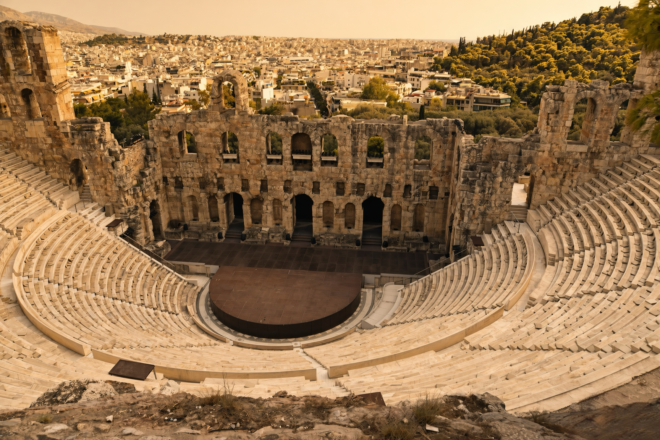
My uncle was a Holocaust survivor and a humanist – Jewish, obviously, though that fact is almost incidental to this story. As a boy I was lucky enough to spend time with him in Paris, where I received a first-rate education in humanism, classical languages, and the moral seriousness of literature. He was exacting. At Pompeii, if I could not ask for a glass of water in Latin, I did not get one. It sounds like a small thing, a pedant’s game, but it tells you something about the man: knowledge and ethics were, for him, inseparable disciplines, and both had to be earned. The first Greek play he gave me to read was Aeschylus’ Suppliants. It has stayed with me ever since, and I return to it now to think through our obligations to refugees and to the homeless of the earth.
Aeschylus’ Suppliants (also known as The Suppliant Women or Suppliant Maidens), produced around 463 BCE, remains one of the most direct dramatic explorations in surviving ancient literature of the ethics and politics of receiving refugees. The play stages the arrival in Argos of the fifty Danaids – daughters of Danaus – who have fled Egypt to escape forced marriage to their cousins, the sons of Aegyptus. They arrive as foreign women, perform the ritual of hiketeia (supplication), and petition King Pelasgus for protection. What follows is not a simple morality tale but a sustained examination of competing claims: the sacred duty owed to the vulnerable stranger, the practical risks to the host community, and the difficult, distinctly political process of collective decision-making under uncertainty. In an era marked by large-scale displacement, the tragedy offers a framework for arguing that societies carry genuine moral obligations to those fleeing persecution, while refusing to sentimentalise the dangers that accompany acceptance. The play insists that both the obligation and the dangers are real, and that responsible action requires confronting both without collapsing into either absolutist openness or reflexive exclusion. This is, I think, its permanent value: not as a policy manual but as a discipline of honest reckoning.
The Plot and Structure
The plot centres on the Danaids’ flight and their appeal. Having left “the delicate soil bordering Syria,” in the words of one common rendering, they cross the sea and reach the shore of Argos, taking refuge at the altars and invoking Zeus Hikesios, the protector of suppliants. Their father Danaus, who has accompanied them, advises restraint and humility: they are to present themselves as helpless, modest, and respectful of Argive customs, aware that their situation as unmarried foreign women arriving unescorted might easily be misread. When King Pelasgus appears, the women advance both a moral and a genealogical claim. They emphasise their vulnerability and invoke a distant kinship through the Argive princess Io, who – transformed into a heifer and driven by a gadfly across the known world in an earlier myth – had wandered to Egypt generations before and become their ancestress. The claim of kinship is real but attenuated; centuries and a change of country separate the Danaids from any straightforward Argive identity.
Pelasgus faces an immediate and structurally difficult dilemma. To reject the suppliants risks the wrath of Zeus and the ritual pollution (miasma) of the land – a danger the Greek audience would have understood as neither superstitious decoration nor mere plot device but a live theological and civic hazard. To accept them, however, invites war with the pursuing Egyptian force and potential division within Argos itself. Rather than decide unilaterally, the king does something notable for a monarch in early Greek myth: he refers the matter to the Argive assembly, refusing to let the fate of a city rest on his private judgment or his private virtue. The people vote to grant the women asylia – protection from seizure – along with a form of resident status. When the Egyptian herald arrives and attempts to drag the women away by force, in one of the play’s most physically violent scenes, the Argives stand by their collective decision, accepting the near-certainty of conflict. The surviving play ends with the Danaids under Argive protection, their immediate safety secured but their future radically unresolved. The larger trilogy, of which only this first play survives complete, apparently continued into far darker territory: the forced marriages eventually proceed, and – according to later mythographic tradition – the Danaids kill their husbands on their wedding night, all but one of them, Hypermnestra, who spares her husband Lynceus out of love. The trilogy’s final play seems to have dealt with her trial and eventual vindication. We should not read Suppliants in isolation from this trajectory, because Aeschylus almost certainly wrote it with the sequel already in view, and the audience, familiar with the myth, would have watched the first play’s welcome with the second play’s violence already shadowing it.
The Ground of Obligation
This structure allows Aeschylus to dramatise moral obligation with unusual clarity, and to root it in something firmer than sentiment. The primary ground of duty is religious and customary. Zeus protects those who supplicate at the altars; to drive them away is an offense against the god and against dik? (justice) itself. The Danaids repeatedly appeal to this higher law, reminding Pelasgus and the audience that hospitality to the stranger is not civic generosity extended at will but a binding claim with cosmic sanction. Pelasgus acknowledges its force even as he weighs its costs; he never denies the obligation exists, only agonises over how to discharge it without destroying the city he is bound to protect. In the Greek world, xenia (guest-friendship) and the protection of hiketai (suppliants) formed part of a shared ethical vocabulary that transcended the boundaries of any single polis. The gods themselves were understood to wander the earth in disguise, testing human generosity – a motif recurring from Homer’s Odyssey, where inhospitality to the stranger is treated as one of the gravest civic failures, through later Greek and Roman folk tradition. Refusal of the stranger therefore carried not only political but cosmic risk. Crucially, the play does not treat this obligation as optional charity, a matter of the host’s private virtue. It presents protection of the suppliant as a binding claim that a community cannot ignore without diminishing itself – without ceasing to be the kind of community that can claim justice for itself in turn.
Solidarity Across Difference
Beyond the divine sanction, the tragedy gestures toward a broader human solidarity that anticipates later philosophical universalism. The Danaids are women, foreigners, and powerless relative to the armed men pursuing them. Their plight invites recognition of shared vulnerability that does not depend on shared citizenship. Although they claim Argive ancestry through Io, the play pointedly does not reduce their case to a simple matter of repatriating kin. Their Egyptian origin, appearance, and customs mark them as other; Pelasgus initially questions their identity, their dress, their manner of supplication, wondering aloud whether they are Egyptian, Libyan, or some other foreign people entirely – a moment of genuine uncertainty Aeschylus does not resolve quickly. The decision to protect the Danaids therefore involves extending protection across difference, not merely welcoming home a lost branch of the family. In this respect the drama anticipates later articulations of cosmopolitan duty: the idea that human beings owe something to one another simply by virtue of shared humanity, independent of citizenship, blood, or custom. Terence’s later line from Roman comedy – that nothing human is alien to the speaker – finds an earlier, more politically charged expression here, in the collective choice of a city to treat foreign women as entitled to safety on grounds that reach beyond kinship. The Stoics would later formalise this intuition into a doctrine of cosmopolis, a single moral community of rational beings; Cicero would adapt it into a Roman theory of natural law binding on all peoples regardless of civic status. Aeschylus, writing more than a century before the Stoa was founded, dramatises the intuition before it acquires its philosophical vocabulary – which is, arguably, exactly what tragedy is for: staging the moral experience that philosophy will later try to systematise.
The Reality of Danger
Yet Aeschylus refuses to present acceptance as costless or risk-free, and it is this refusal that gives the play its enduring seriousness rather than turning it into propaganda for open borders avant la lettre. The dangers are stated repeatedly and with real dramatic force, not as a rhetorical concession quickly brushed aside. Pelasgus fears, explicitly and at length, that welcoming the Danaids will bring war upon Argos. The Egyptian cousins are not abstract villains conjured only to be defeated; they arrive, in the person of their herald, as an armed and determined force convinced of the legitimacy of their claim. Protecting the women means accepting the possibility of bloodshed and the deaths of Argive citizens who bear no personal stake in the Danaids’ quarrel. There is also the danger of internal division. The king worries aloud that the people will later blame him for endangering the city on behalf of people who are, after all, strangers – a fear that speaks directly to the perennial political problem of asking citizens to bear costs on behalf of non-citizens. The assembly’s eventual unanimity does not erase the underlying tension between moral aspiration and self-preservation; it merely transfers responsibility for that tension from one man to the collective body of the polis, where, arguably, it belongs.
A third and more uncomfortable danger concerns the character and long-term trajectory of the newcomers themselves. The Danaids are not idealised innocents, and Aeschylus does not ask us to pretend otherwise. Even within the surviving play, their desperate threat to hang themselves from the altars if denied protection reveals a capacity for extremity that should give any audience pause – a will capable of drastic, even violent, self-assertion. Later tradition, and apparently the lost plays of the trilogy, shows forty-nine of the fifty sisters murdering their bridegrooms on their wedding night, a mass act of premeditated violence that complicates any simple narrative of grateful refugees quietly integrating into their host society. Acceptance, the trilogy as a whole suggests, carries the risk of importing conflict that does not end with the initial act of welcome, and of discovering that the protected may not share, or may only partially share, the host community’s deeper values and constraints. A dramatist less serious than Aeschylus could have ended the story with the Argive vote and let the audience leave the theatre reassured. Aeschylus, we can reasonably infer, did not.
Pelasgus’s Method
These dangers are not dismissed, and the play’s power lies precisely in holding the moral claim and the practical risks in unresolved tension rather than resolving them prematurely in either direction. Pelasgus never claims that Argos has unlimited capacity or that acceptance will be painless; his agonised deliberation on stage is itself an argument against both naive welcome and reflexive refusal. He proceeds by democratic deliberation, forcing the community as a whole to own the decision rather than allowing a single ruler to absorb the responsibility, or to escape accountability by hiding behind an unaccountable decree – a significant political choice, given that Aeschylus was writing in Athens in the decades after the Cleisthenic reforms, when the practice of collective deliberation was being actively worked out. The partial claim of kinship through Io softens the pure otherness of the Danaids, offering a bridge that makes acceptance more psychologically palatable to an anxious citizenry, reaching for whatever thread of commonality is available rather than resting obligation on abstraction alone. Yet the core decision remains one of extending protection to people who are, in the first instance, foreigners fleeing a specific and gendered form of coercion. The tragedy thus models a form of political seriousness that modern debate too rarely achieves: the obligation is real, the dangers are real, and neither can be wished away by rhetoric.
Modern Parallels
Modern refugee policy confronts analogous tensions, even if the scale, legal architecture, and technologies of displacement differ enormously from anything available to a fifth-century Argive assembly. Contemporary international law, particularly the 1951 Refugee Convention and its associated principle of non-refoulement, codifies an obligation not to return people to places where they face persecution or serious harm. This principle rests on a recognition of human vulnerability and the moral claim of those fleeing violence, political oppression, or targeted threats – claims that echo the Danaids’ appeal at the Argive altars almost exactly. Historical experience broadly reinforces the underlying intuition. Societies that have absorbed refugees have, over the long run, often gained real cultural and economic benefit from doing so; societies that have systematically refused protection to people in genuine danger have frequently incurred lasting moral injury and, in the most extreme cases, direct complicity in the harms that followed from turning people away. The refusal of Jewish refugees by numerous states in the 1930s, my own uncle’s history among them, is the paradigm case that any honest contemporary argument about asylum must reckon with.
But the obligation, as Aeschylus already understood, is not absolute or unlimited, and treating it as such does not honour the play’s argument but flattens it. States retain a legitimate interest in controlling their borders, in distinguishing genuine refugees from those seeking migration for other reasons, and in setting reasonable conditions for entry and integration. Capacity is finite in any real polity, ancient or modern. Rapid, large-scale inflows can strain housing, welfare systems, social trust, and public order, particularly where cultural distances are wide or integration policy is inadequate. Security risks – including the possibility that some arrivals may bring, or come to develop, hostility toward elements of the host society – cannot be dismissed merely as prejudice dressed up in policy language; Aeschylus himself does not dismiss them, dramatising them through the herald’s violence and the Danaids’ own capacity for lethal extremity. The herald’s attempt to seize the Danaids by force has modern parallels in the challenges of managing failed asylum claims and returns, and of responding honestly when protected populations become, in some instances, sources of further conflict rather than simple beneficiaries of hospitality.
What the Play Offers
The play’s value for contemporary argument lies precisely in its refusal of simplification. An argument for moral obligation that ignores danger becomes utopian and, over time, politically brittle – it cannot survive contact with a single bad outcome, because it has never prepared its adherents for the possibility of one. An argument that elevates danger into a blanket rationale for exclusion becomes callous and, over time, corrosive of the host society’s own ethical self-understanding – it purchases safety at the price of the very civic identity it claims to be protecting. Aeschylus stages the intermediate position, and it is a harder position to hold than either extreme, which is presumably why it requires an entire tragedy to dramatise rather than a slogan to state. The Argives accept the Danaids because the alternative – driving desperate people from the altars of the gods – would violate a fundamental norm on which their own claim to civic legitimacy rests. They do so with open eyes, knowing that war may follow and very possibly will. The decision is collective rather than the fiat of a single leader, which distributes both the risk and the responsibility across the whole citizen body rather than concentrating either in one man’s conscience. It is conditioned by claims of shared humanity and limited, partial kinship, not by a demand for total cultural erasure on the part of the newcomers or by a fantasy of frictionless, cost-free open borders on the part of the host. Subsequent complications in the mythic cycle – the murdered bridegrooms, Hypermnestra’s trial – remind us with real dramatic weight that acceptance does not guarantee harmony, gratitude, or a clean resolution; it is the beginning of a relationship, not its conclusion.
Applying the Framework
Applying this framework honestly to the present day requires distinguishing categories that the play itself, in its way, already distinguishes. Not every person crossing a border is a refugee in the strict sense of fleeing persecution or mortal danger. Economic migration, while frequently driven by real hardship, raises different ethical and practical questions from the protection of those facing targeted violence or the collapse of basic security. The Danaids’ case, fleeing a coercive forced marriage backed by armed pursuit, sits closer to the latter category. Modern states can, and in my view should, maintain robust and fair procedures for assessing claims, precisely because false or exaggerated claims undermine political support for genuine ones – a dynamic Pelasgus would have recognised, given how much of his anxiety concerns the Argive citizenry’s willingness to trust his judgment. Integration, meanwhile, is never automatic in myth or in life. Successful inclusion requires both the willingness of newcomers to adapt to the host society’s core civic norms, and the willingness of the host society to extend meaningful opportunity rather than a permanently conditional welcome. Where either side fails, the dangers Aeschylus identified twenty-five centuries ago – resentment, division, secondary conflict – reappear in recognisably contemporary form.
Objections
Critics of expansive asylum policy sometimes argue that ancient examples are simply irrelevant to modern conditions, because contemporary welfare states, mass communication, and demographic scale create pressures entirely unknown to a small classical polis. The objection carries genuine force and should not be dismissed lightly, in keeping with the play’s own insistence on steelmanning the difficult case rather than caricaturing it. Argos, whatever its mythic population, was by any modern measure a small community with a comparatively simple administrative apparatus; today’s nation-states manage vastly larger numbers of people and more complex bureaucracies than an assembled citizen body voting in person at a single meeting. Scale genuinely changes the calculus, and it would be intellectually dishonest to pretend that a decision Argos made about fifty women translates in any straightforward way to a modern state’s decision about hundreds of thousands arriving over years.
Yet the underlying ethical structure remains recognisable even once these differences are granted their full weight. The claim of the person in genuine fear of persecution still carries real moral weight, whatever the surrounding administrative complexity. The risk to the receiving community’s security, cohesion, and finite resources remains a legitimate consideration, not a euphemism that can simply be unmasked as prejudice and set aside. Democratic deliberation – however imperfect, however captured at times by demagoguery or bad information – remains preferable in principle to unilateral decree from above or to the quiet abandonment of the vulnerable at the border, because it distributes both the moral credit and the moral cost across the whole community that must live with the consequences. Aeschylus does not resolve the tension by declaring that obligation always overrides danger, nor the reverse. He presents a community that accepts the refugees, accepts the associated risks with clear eyes, and thereby defines itself, through that act, as one that takes both the stranger and its own citizens seriously at once.
Conclusion
The enduring force of Suppliants is that it treats the arrival of the refugee as a test of character for the host, not merely a logistical or security problem to be managed. Refusal may preserve short-term safety at the cost of moral coherence – a bargain that looks attractive in the moment and corrosive in retrospect. Acceptance may preserve moral coherence at the cost of real hardship, real risk, and, as the trilogy’s later plays suggest, potentially real violence still to come. Neither path is free, and any account of asylum that pretends otherwise, in either direction, has stopped being honest. The tragedy’s achievement is to make both the obligation and the danger visible at the same time, without allowing either to cancel the other out or to provide a comfortable alibi for avoiding the harder judgment. In that respect it remains a more rigorous guide for contemporary argument than either pure humanitarian sentiment, which forgets that communities have finite capacity and legitimate fears, or pure realist exclusion, which forgets that communities also have obligations that precede and exceed their own self-interest.
Societies confronting large-scale displacement will continue to face versions of Pelasgus’ choice, dressed in modern legal and administrative language but structurally unchanged. The play does not dictate the precise policy outcome for any given crisis, and it would be a misreading to extract from it a simple prescription. It does insist, with the full force of tragic form, that the choice cannot be made honestly without acknowledging both the weight of the moral claim and the gravity of the risks. To accept refugees under appropriate conditions is not an act of naivety; it is an act that recognises shared human vulnerability while remaining clear-eyed about the costs that recognition may carry. To refuse them without serious, individualised examination of their claims is not prudence; it is a narrowing of the moral imagination that the Argives, for all their fears and for all the violence still to come in the trilogy, ultimately declined to accept for themselves. My uncle, who survived what the century’s worst refusal of hospitality made possible, understood this without needing the philosophical vocabulary to state it abstractly; he simply handed a boy a play and let the play do the teaching. Aeschylus leaves us with that difficult, unresolved, and still entirely necessary balance – and, more than two thousand years on, we are still, rightly, being asked to hold it.
– – –
Bakchos is the founder of Blak and Black, an Australian media and advocacy platform established in 2010. Bakchos writes from the intersecting perspectives of Wiradjuri heritage, Jewish identity, and humanism.
© Bakchos, August 2026


Written around 463 BCE, Suppliants dramatises a decision every era of displacement forces on a host community — the Danaids’ claim of sanctuary, King Pelasgus’s refusal to decide alone, and the Argive assembly’s vote to accept both the obligation and the risk of war that comes with it.
A powerful post which reads the play alongside the 1951 Refugee Convention and the principle of non-refoulement, arguing that Aeschylus already understood what most modern debate flattens: the moral claim of the refugee and the practical dangers of acceptance are both real, and neither cancels the other out
The way the west is currently treating refugees. Refugees I might add, the west is largely responsible for creating. It’s a classic example of man’s inhumanity to man.
The sad thing is everyone, apart from the Greens, are in a race to the bottom with Pauline Hanson.
Mark I enjoy our conversations in Classical Greek, this is one of your favourite subjects. Now I understand why. Your essay’s central claim is that Suppliants retains permanent value precisely because it refuses simplification. It stages an intermediate position: societies have genuine obligations to those fleeing persecution, but acceptance is never costless, and responsible policy requires honest reckoning with both the weight of the moral claim and the gravity of the dangers. Neither pure humanitarian sentiment nor pure realist exclusion is adequate. The tragedy offers a discipline of judgment rather than a policy prescription, one the author links back to the lessons of his uncle’s life and the play’s enduring force more than two thousand years later, that’s how I read your essay. Have I got it right?
Hello Margaret. Yes you’ve read my essay correctly. On a side note, I too enjoy our dinner conversations in Ancient Greek. I just hope that our invocations don’t actually result of one or more of the Olympians joing us at the dinner table.
I haven’t read Aeschylus in this way before, I think that you’re right but I have to give it some more thought.
Thanks Bill. I think there are some direct parallels between Aeschylus and the refugee convention.
That’s an interesting post, Bakchos. An interesting and thought provoking read.
To accept refugees under appropriate conditions is not an act of naïvety; it is an act that recognises shared human vulnerability while remaining clear-eyed about the costs.
We caused the wars. We have a moral obligation and legal obligation to accept the refugees that we create by facilitating the wars that created the circumstances in which they became refugees.