
Abstract
Eighty years after Soviet troops opened the gates of Auschwitz-Birkenau, the camp’s memory is contested rather than settled. This essay examines Auschwitz’s establishment and liberation, the 2025 eightieth-anniversary commemorations held under the shadow of a Russia excluded for its own war of aggression, and the accelerating pressure on Holocaust memory from artificial intelligence, social media, and a documented rise in antisemitic incidents across Europe, the United States, and Australia – culminating in the December 2025 terror attack at Sydney’s Bondi Beach. It also weighs the competing explanations for that rise, the genuine controversy surrounding Australia’s institutional response to it, and the limits of the data underpinning both.
Introduction
The Holocaust is not receding into history at the gentle pace of ordinary memory; it is being actively contested. Auschwitz was liberated eighty years ago, but the anniversary arrived in a Europe measurably more anxious about antisemitism than the one that marked the sixtieth in 2005, and an Australia that at the end of 2025, buried victims of a mass-casualty antisemitic terror attack on its own soil. What follows tries to hold two things at once: the seriousness of that trend, and the seriousness of the argument, made by credible critics, that some of the institutional response to it has itself overreached.
The Establishment and Liberation of Auschwitz
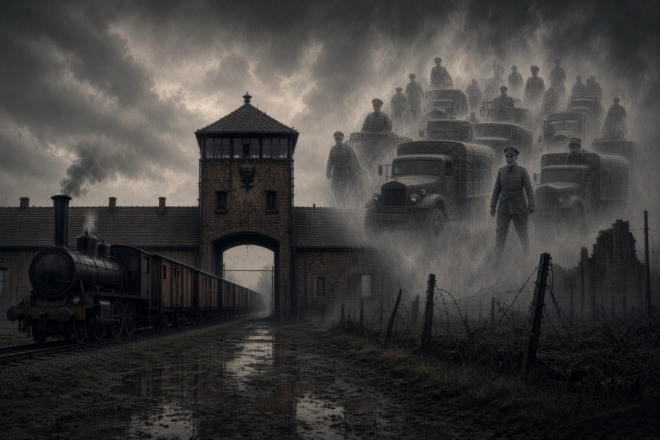
Auschwitz was founded in 1940 in the Polish town of Oświęcim, shortly after the German invasion of Poland. It began as a camp for Polish political prisoners – resistance members, Catholic priests – before evolving, as Nazi genocidal policy escalated, into the central site for the extermination of Jews, Roma, and others the regime deemed unfit to live. Auschwitz II-Birkenau became the operational heart of that machinery: victims arrived in cattle trains, were subjected to brutal ramp-side selections, and were divided between forced labour and immediate death. Approximately 1.1 million Jews were murdered at Auschwitz alone, within a broader genocide that claimed six million Jewish lives across Europe.
On 27 January 1945, Soviet troops entered Auschwitz and found roughly 7,000 surviving prisoners, most gravely ill or starving. Eyewitness accounts from that day – Boris Polevoy’s among the most cited – remain among the starkest documentary evidence of what the camp had been.
Eighty Years On: Commemoration in a Fractured Present
The eightieth-anniversary commemoration on 27 January 2025 was built around survivors rather than statesmen, held in a tent over the gate to Auschwitz II-Birkenau, with a global broadcast intended for shared witness. Russia – whose Red Army liberated the camp – was notably absent, and Memorial director Piotr Cywi?ski said plainly that he found it hard to imagine Russia’s presence given its invasion of Ukraine, calling such attendance cynical while leaving the door open for the future. Memory does not exempt a nation from present-day judgment.
Reading the Data Honestly: What Else Might Explain the Rise
Before treating the post-2023 antisemitism data as self-evidently proof of a single, linear trend, it is worth considering the alternative readings, because a case built only on the most alarming figures is a case that collapses under scrutiny.
Geopolitical polarisation and definitional slippage. A significant share of what gets counted as an “antisemitic incident” post–October 2023 is bound up with reaction to the Gaza war – protest activity, harsh criticism of Israeli government conduct, and rhetoric that critics on one side call legitimate political speech and critics on the other call antisemitic by proxy. The contested IHRA working definition sits at the centre of this – its own lead drafter has objected to its use as an enforcement instrument, and Australia’s own Human Rights Institute has argued Segal’s plan overreaches its terms of reference, particularly where it touches universities, media, and charitable status. Some proportion of the raw incident count reflects this definitional dispute rather than a uniform rise in classical Jew-hatred.
Platform and moderation dynamics, not just user sentiment. The picture is not simply “more people becoming antisemitic.” Critics note that since major platforms relaxed hate-speech moderation, extreme content – including Holocaust denial and Hitler praise – has stayed online at higher rates, even in the aftermath of the Bondi attack, which suggests part of the visible surge is a distribution and enforcement failure rather than a pure attitudinal one.
Institutional-capture concerns cut both ways. Critics of Australia’s antisemitism envoy model – not fringe voices, but the Australian Human Rights Institute and the Race Discrimination Commissioner among them – have flagged the plan’s more punitive recommendations, including funding threats to universities and a proposed media-monitoring role, as overreach beyond an advisory mandate. That critique deserves to sit alongside the data on rising incidents, not be crowded out by it. A response to antisemitism that itself concentrates unaccountable power is a legitimate governance concern, independent of whether antisemitism is rising.
None of this dissolves the underlying trend – the data across five independent sources (EU Commission, Blue Square Alliance, CST, ECAJ, MEMRI) converges too consistently for that. But the honest version of this essay holds the trend and the contestation over its causes and its institutional response in the same hand.
The Machinery of Forgetting – With a Correction
Generative AI is a genuine new vector for Holocaust distortion, but the picture is more mixed than “AI is accelerating denial” alone suggests. Research from the World Jewish Congress found that leading chatbots actually demonstrated real capacity to recognise nuanced Holocaust denial and distortion, including coded language – evidence that text-based safeguards, while imperfect, are not absent. Meta’s content policy leadership has said explicitly that Holocaust denial and distortion are removed as hate speech regardless of factual dispute, and safeguards on image and video generation have improved, if unevenly – the ADL’s Center for Technology and Society tested four AI video generators against 50 hateful prompts and found OpenAI’s Sora 2 performed best, refusing 60% of them, though all four tools still produced antisemitic content in a substantial minority of cases. The more precise claim, then, is not that AI has replaced human-driven distortion but that it has lowered the cost of producing image and video-based denial content specifically, at the moment when survivor testimony – down from roughly 220,000 living survivors a year ago to about 196,600 now – is thinning. Classical, human-authored antisemitic tropes remain the dominant vector by volume; AI is a force multiplier on the edges, not yet the main current.
Australia: From Graffiti to a Massacre – and What Happened Next
The Executive Council of Australian Jewry documented 1,654 anti-Jewish incidents nationally between October 2024 and September 2025, on top of 2,062 the year before – almost five times the pre-October 2023 average. That escalation culminated on 14 December 2025 in a terror attack on a Hanukkah celebration at Sydney’s Bondi Beach that killed at least fifteen people. Prime Minister Anthony Albanese called it evil and beyond comprehension.
It would be rhetorically convenient, but inaccurate, to say government inaction caused that attack. According to the Prime Minister’s office, the government had by mid-2026 formally adopted the 13 recommendations and 49 actions set out in Segal’s Plan to Combat Antisemitism, and had already legislated new hate-speech, hate-crime, hate-symbol and doxxing offences, alongside appointing a Student Ombudsman. The more defensible criticism is narrower and, frankly, sharper: critics note that in practice, platform enforcement moved in the opposite direction to the plan’s intent, with extreme content persisting online even after Bondi. Separately, and on genuinely different grounds, commentators have raised concerns about the scale and accountability of the Envoy’s own office – its budget, its role in adjudicating speech, and its concentration of authority without an electoral mandate – a critique that comes from civil liberties and press-freedom concerns, not from antisemitism denial. Both criticisms can be true simultaneously: the state’s legislative response may be under-enforced on platforms while its advisory apparatus is, on a separate axis, over-reaching. Collapsing that into a single “the government did nothing and people died” line does a disservice to how contested and multi-directional this actually is.
The classroom-level evidence remains the least ambiguous part of the record: Australian schools have recorded incidents including a Jewish student’s photograph defaced with the words “gas inhaler” and a peer telling another student to die in a gas chamber. A witness before the Royal Commission on Antisemitism and Social Cohesion put the deeper problem plainly: poorly designed Holocaust education can entrench the prejudice it means to dismantle – which argues for rigour in how remembrance is taught, not simply more of it.
Contested Memory: Universality, Specificity, and the Anti-Zionism Question
The debate between universalist remembrance (including Roma, disabled people, political prisoners, and Soviet POWs murdered alongside Jews) and Jewish-specific remembrance is real and not resolvable by fiat. But there is a third, harder question: when does anti-Zionist framing function as a vehicle for classical antisemitic tropes, and when is it legitimate political criticism of a state’s conduct? The IHRA working definition, notably, was drafted to make exactly this distinction – its own lead author has been explicit that legitimate criticism of Israeli government policy is not, in itself, antisemitism. The practical failure is not in the definition’s text but in its application: institutions invoking it inconsistently, or stretching it to cover speech its drafters intended to exclude. That gap between the document and its use is precisely why any single office claiming final interpretive authority over where that line sits – without external accountability – deserves scepticism regardless of which direction the overreach runs. Researchers studying online hate have separately documented language shifting in real time to exploit this ambiguity – “Auschwitz” itself has been repurposed as a verb in some online commentary to characterise Israeli conduct in Gaza – a case that is genuinely hard to adjudicate even under a well-applied definition.
A Note on Sources and Their Limits
The incident figures cited here (ECAJ, EU Commission, CST, Blue Square Alliance) are drawn from advocacy-adjacent monitoring bodies with a direct stake in the findings, and depend on voluntary community reporting, which is known to undercount incidents victims consider too minor, too personally risky, or too futile to report – and to be sensitive to which behaviours get classified as antisemitic in the first place, a live definitional dispute discussed above. These are the best available figures, not neutral ones, and should be read as a floor and a direction of travel rather than a precise census.
Conclusion: Toward Prioritised, Not Performative, Remembrance
Auschwitz’s legacy was never meant to be revisited once a year on a fixed date. If this essay has a single practical claim, it’s that remembrance divides into three distinct jobs that are currently being conflated: enforcement (prosecuting incitement and violence – the one area with the least room for reasonable disagreement); platform accountability (closing the gap between what hate-speech law says and what actually stays online, which the evidence suggests is currently the weakest link); and education design (rigorous, evidence-tested Holocaust curricula, since poorly built programs can backfire). Conflating these three into a single undifferentiated “do more” – or into a single office with authority over all three – serves neither victims of antisemitism nor the civil liberties of everyone else. Eighty years on, Auschwitz still sets the same task it always did: not simply to remember, but to be precise about what remembering requires.
– – –
Bakchos is the founder of Blak and Black, an Australian media and advocacy platform established in 2010. Bakchos writes from the intersecting perspectives of Wiradjuri heritage, Jewish identity, and humanism.
© Bakchos, August 2026



Netanyahu isn’t helping the image of Jewish people living outside of Israel, but that doesn’t in and of itself explain the rise of antisemitism and holocaust denial. Holocaust denial is one of the main topics for populist politicians in the west. With the growth of AI. It’s becoming more prevalent and more dangerous..
In my honest opinion, the actions of Israel under the Prime Ministership of Netanyahu are making the lives of the Jewish diaspora more difficult.
I can’t believe, that despite all the evidence, there are still Holocaust deniers.
Until Israel stops its genocide in Gaza, global antisemitism will continue to rise.