
Introduction
Euphemism is not the master key to politics. It does not explain war, austerity, or the persistence of injustice, and treating it as though it did flatters the critic more than it illuminates the subject – as if naming a linguistic trick were the same as defeating the power behind it. What euphemism is – and this is a narrower, more defensible claim – is one of the principal instruments by which power evades accountability for what it does. It sits alongside other instruments: secrecy, spectacle, legal technicality, sheer exhaustion of the public’s attention. Its specific contribution is linguistic: it lets an institution describe an act without describing what the act actually consists of, so that agreement can be secured before anyone has to picture what they are agreeing to.
George Orwell made this case in 1946, in “Politics and the English Language,” and then dramatised its furthest extension three years later in Nineteen Eighty-Four. An argument that stops there repeats Orwell’s own error at one remove, trading live inquiry for a set of ready-made moves – treating euphemism as one fog rather than several distinct mechanisms, catching only one political tendency in the net, and forgetting that plain, concrete language is not automatically honest. Orwell himself understood that last point better than the tidy version of his argument usually credited to him; what follows tries not to forget it either.
Orwell’s Mechanism, Narrowed
Orwell’s claim in “Politics and the English Language” was that political writing is, to a great extent, “the defence of the indefensible,” and that this defence depends on avoiding language concrete enough to conjure a mental picture. If a village is destroyed from the air and its inhabitants killed, the plain sentence describing that event is close to unbearable to write. “Pacification” removes the image and leaves only the administrative shell.
Orwell isolated three tactics that perform this removal: the euphemism itself (softened term for a brutal act); orthodox phraseology (pre-fabricated phrases that let a speaker avoid the effort, and the risk, of original thought); and vague, grandiose abstractions (democracy, freedom, justice) deployed as though self-evident, when in fact each faction quietly fills them with a different, unstated content. What unites these tactics is not moral failing so much as function: each interposes a layer of insulation between the words and the reality the words are nominally about, and that insulation is valuable to anyone whose actions would not survive being pictured plainly.
Newspeak as the Limit Case, Not the Norm
Nineteen Eighty-Four imagines what happens if this tendency is engineered rather than merely indulged – if a language is built so that evasion becomes structurally unavoidable. Newspeak’s three vocabularies attack the problem from different angles: the A vocabulary strips ordinary words of nuance and ambiguity; the B vocabulary consists of compound political terms that arrive pre-loaded with the Party’s verdict built into their syllables – goodthink, crimethink, joycamp for a forced-labour camp – so that using the word is already accepting the judgment; the C vocabulary fragments technical knowledge so finely that no single vocabulary exists broad enough to conceive of “Science” as a coherent, potentially threatening body of independent inquiry.
Newspeak also deletes gradation. Antonyms disappear where a prefix will do – bad becomes ungood – and intensifiers collapse into a single mechanical stack: plusgood, doubleplusgood. The result, in Syme’s ideal, is duckspeak: ideologically correct phrases emitted from the larynx without the higher brain centres ever being consulted, speech that has become pure reflex.
It is worth being honest about what this limit case is for. Real political language almost never approaches Newspeak’s totality, and treating every euphemism as a small step on a slippery slope toward duckspeak proves too much – it collapses the difference between an institution reaching for a comfortable phrase and a state that has actually redesigned its language to make dissent unspeakable. Newspeak is useful as a diagnostic extreme, a way of seeing the ordinary mechanism magnified rather than a description of how most political speech behaves. But the magnification is instructive precisely because Newspeak’s three vocabularies are not one undifferentiated device – the B vocabulary’s pre-loaded compounds work by concealment, smuggling a verdict inside a word; the C vocabulary’s fragmentation works by jargon, walling off comprehension along expert lines; the deletion of gradation works by bureaucratic flattening, replacing a judgment with a mechanical scale. Ordinary political language keeps these three mechanisms separate rather than fusing them into one engineered system, which is exactly why they reward separating.
A Taxonomy, Not a Catalogue
Ordinary political euphemism does not operate as a single undifferentiated fog. It is worth separating at least four distinct mechanisms, because they conceal in different ways and call for different kinds of scrutiny.
Concealment substitutes a term that hides the nature of the act itself. “Collateral damage” for civilian deaths; “enhanced interrogation techniques” for torture. The listener is not given false information exactly – they are given true information from which the morally decisive content has been surgically removed.
Bureaucracy distances an institution from responsibility for an act by folding it into administrative process. “Right-sizing” for mass layoffs; “revenue enhancement” for a tax increase. Here the trick is not hiding the act but draining it of agency – the passive machinery of “adjustment” replaces a decision someone actually made.
Jargon uses a technical or clinical register to exclude the general public from full comprehension rather than to conceal any single fact. “Kinetic operations” is not really hiding that force was used; it is placing the description in a register – quasi-scientific, quasi-military – that ordinary civic vocabulary cannot easily interrogate, because it borrows the authority of expertise to foreclose lay objection.
Naming-contests are different in kind from the other three: here, two or more terms compete openly for the same referent, and neither side is straightforwardly hiding anything – each is trying to win the argument by winning the noun. This is euphemism’s most political form, because it is symmetrical: it is available to, and used by, every faction with a stake in the outcome. The contest does not always stay symmetrical, though – often one side has a coined term circulating in institutions, media style guides, and legislation well before any opposing term is coined at all, so that the “contest” for long stretches consists of a single label being smuggled into ordinary public use unopposed, quietly settling the question by attrition before a rival noun ever arrives to contest it.
These four are not hermetically sealed categories so much as four angles of attack on the same underlying move, and most real specimens combine more than one. “Enhanced interrogation techniques” is simultaneously a concealment (torture renamed) and a piece of jargon (a legal-sounding compound structure built to resist casual objection). “Right-sizing” is bureaucratic distancing built entirely out of the vocabulary of correction and fit, but it is also, in a modest way, jargon – borrowing a term from manufacturing and logistics to make a layoff sound like an engineering adjustment. The typology is a way of asking better questions of a given example, not a filing system it will consent to sit still for.
Balancing the Sample
If this mechanism is genuinely general, it should not present as a vice peculiar to one political tendency. Security-state concealment (“enhanced interrogation,” “neutralize”) sits recognisably on one end of a familiar spectrum; “tax relief” does comparable work from a third position, smuggling a policy conclusion into a noun before any argument has been offered for it. Take “equity” as the demonstration case: the word names a real and contested distributive question, but its public use routinely skips past that question rather than answering it – a policy document can commit an institution to “advancing equity” and secure broad assent, because the sentence has not yet specified whether it means equal treatment, equal outcomes, or targeted redistribution, three positions serious people disagree about sharply. The vagueness is not incidental to the word’s popularity; it is the reason a coalition that could not agree on any of the three specific policies can still agree on the noun. That is euphemism’s bureaucratic-naming-contest hybrid at work, not a special vice of one side of politics.
Two Phrases, Examined Closely
“Collateral damage”
The phrase is instructive precisely because it is not partisan; it has been used by every major military power for decades, regardless of the government in office. Its grammatical structure is doing specific work. “Collateral” means secondary, incidental, attached to something else – the phrase’s entire function is to assert, before any facts are examined, that civilian death is a side-effect rather than a foreseeable consequence of a targeting decision. “Damage” completes the operation by placing human death in the same category as damage to property or equipment – a category that can be tallied, minimised, and weighed against military objectives without the vocabulary ever being forced to acknowledge that a person, rather than a structure, has ceased to exist. What makes the phrase durable rather than merely cynical is that it is not always used in bad faith – militaries do distinguish, sometimes carefully, between intended and unintended casualties, and the distinction is not meaningless. The euphemism’s danger lies less in the distinction it draws than in how completely the phrase pre-empts scrutiny of that distinction: once “collateral damage” has been said, the sentence is grammatically finished, and the question of whether the targeting decision was in fact reasonable, proportionate, or avoidable has been quietly closed before it was opened.
“Undocumented immigrant vs. illegal alien”
This pair belongs to the naming-contest category, and it rewards close attention precisely because neither term is a neutral report of fact – each is an argument disguised as a description. “Illegal alien” foregrounds legal status as the single most salient fact about the person, and pairs it with “alien” – a word that is, in fact, a genuine term of art in immigration statute, defined there as any person who is not a citizen or national. That legal pedigree is precisely what makes the word useful for dehumanising purposes: its clinical legitimacy lends borrowed authority to a connotation the statute itself does not intend, since outside the code “alien” carries a primary sense of foreignness bordering on the inhuman, and the phrase invites the listener to conclude, before any further information is supplied, that the person’s presence is a violation and their belonging is fundamentally in question. “Undocumented immigrant” foregrounds migration and paperwork instead, reclassifying the same legal fact as an administrative gap – something one lacks – rather than a status one is; but this is not merely softer, it is frequently a misdescription, since many people the phrase names hold documents, issued by another country, and what they actually lack is not paperwork as such but a specific legal status the word “undocumented” quietly declines to name. Both phrases are grammatically complete sentences pretending to be neutral nouns. Both encode a conclusion about how the listener should feel – threatened or sympathetic – inside a two-word label, before any argument has actually been made. The instructive point is that this contest cannot be resolved by simply preferring the “softer” term, because softness is not the same as accuracy in either direction: the correct response to a naming-contest is not to pick a side’s preferred euphemism, but to notice that a contest is occurring at all, and to ask what specific, verifiable facts about the person’s situation are being smuggled past on the strength of a chosen noun.
The Missing Objection: Concrete Language Serves Cruelty Too
Orwell’s prescription – prefer the concrete word to the abstract one – is genuinely useful, but it is not a complete defence against propaganda, and Orwell himself, writing about totalitarianism elsewhere, understood this better than the tidy version of his argument usually credited to him. Concrete, vivid, image-laden language is not inherently honest. It is, in fact, the dominant register of dehumanising propaganda, which typically does not hide behind abstraction at all – it specifies, and specifies viciously. Calling a persecuted group “vermin,” “cockroaches,” or a “plague” is about as concrete and imagistic as language gets; these words are chosen precisely because they conjure an unmistakable mental picture, and the picture is the whole point – it recruits an instinctive, pre-rational disgust response that no abstraction could produce. Genocidal rhetoric across the twentieth and twenty-first centuries has relied overwhelmingly on this kind of vivid dehumanisation rather than on euphemistic vagueness; the concealment, where it exists, tends to arrive only later, in the bureaucratic paperwork that follows the concrete incitement.
This matters for the essay’s argument because it means Orwell’s stylistic cure – concreteness, plain nouns, the avoidance of ready-made phrases – is necessary but not sufficient. A political culture vigilant only against vagueness, and unsuspicious of vivid language as such, has defended against half the threat. The other half arrives dressed as clarity.
The Popular Mythos, and Its Problems
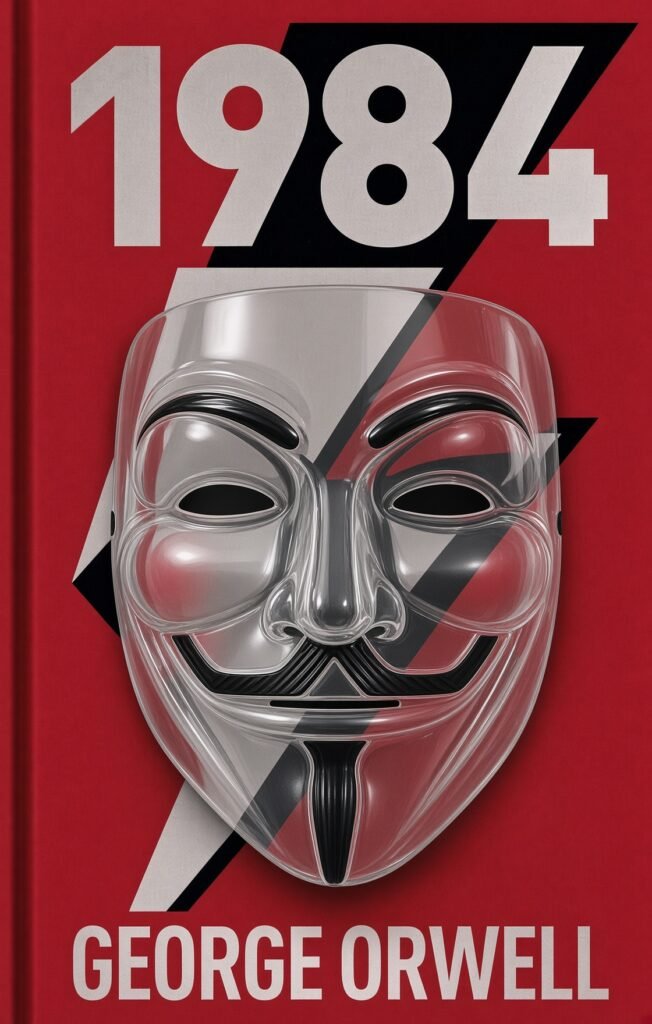
V for Vendetta enters this argument as a mythos rather than a single text, and it is worth being precise about the seam running through it. Alan Moore and David Lloyd’s original graphic novel does contain the core sentiment now attached to the character – that an idea, unlike a body, cannot be killed – spoken by V in a spare form at his own death. But the version that actually circulates, addressed to “Mr. Creedy” and building to “beneath this mask there is more than flesh,” is the 2005 film’s dialogue, written by the Wachowskis for a confrontation the book does not stage in that form. The film took a spare line from a considerably more ambivalent book and dramatised it into something closer to a manifesto – and Moore, uneasy with that transformation among others, publicly disowned the adaptation. What circulates as “V’s philosophy” is therefore a composite, and what follows engages that popular composite rather than claiming to represent Moore’s own, more guarded position.
Read as that composite, the popular V is not a straightforward counterexample to Newspeak’s evasions – a hero who simply speaks clearly where the Party speaks vaguely. He is a more troubling case, because his rhetoric borrows the exact grammatical shape Orwell warned against: grand, undefined abstractions – idea, symbol, the people – asserted with total confidence and never cashed out into anything specific enough to be argued with. “Ideas are bulletproof” sounds like an argument and functions as a slogan, inviting agreement rather than earning it, and the theatrical apparatus around the character – the mask, the anonymity, violence staged as communication – is itself a mythologising technology, not a neutral vehicle for clear thought; a mask obscures exactly as much as a euphemism does, it simply obscures a person instead of a policy. The line that should trouble a careful reader most is “happiness is the most insidious prison of all,” whose totalising shape forecloses, by its own grammar, the possibility that contentment might ever be genuine rather than manufactured – an unfalsifiable claim of exactly the kind Orwell distrusted, regardless of which side issues it. Resistance movements are not exempt from the temptation to mythologise. A movement convinced its own language is transparently truthful, simply because it opposes a regime that is transparently false, has not solved Orwell’s problem. It has relocated it.
Conclusion: A Narrower, More Demanding Vigilance
Vigilance against euphemism is not, by itself, vigilance against political harm. Concrete, vivid language can dehumanise as effectively as abstract language can conceal, and a reader trained only to distrust vagueness will walk directly past propaganda dressed in specific, imagistic nouns – including, sometimes, the propaganda of one’s own side.
– – –
Bakchos is the founder of Blak and Black, an Australian media and advocacy platform established in 2010. Bakchos writes from the intersecting perspectives of Wiradjuri heritage, Jewish identity, and humanism.
© Bakchos, September 2026


The weaponisation of language isn’t something new It’s happened since humanity first developer language, but it remains an insidious thing.
Political language rarely lies outright. More often it withholds the picture that would make agreement harder to secure — “collateral damage” instead of civilian deaths, “right-sizing” instead of layoffs, “special military operation” instead of invasion.
A mask obscures exactly as much as a euphemism does — it simply obscures a person instead of a policy.
Well, chosen words can hide a multitude of sins.