
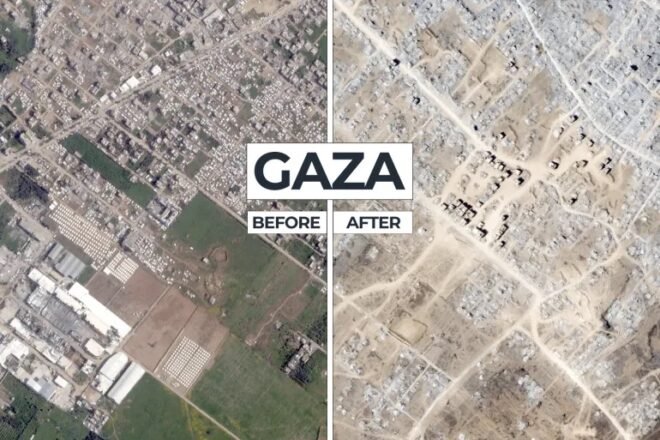
Any honest account of this anniversary has to begin where the first one began. On 7 October 2023, Hamas fighters crossed into southern Israel and killed about 1,200 people, at least 828 of them civilians, among them at least 36 children. They took 251 people hostage into Gaza, where, the United Nations notes, they were subjected to torture, sexual violence and other degrading treatment. Hamas bears direct responsibility for that day, and for fighting from within and beneath civilian areas in ways that predictably raised the cost of any Israeli response. Today Israelis are mourning, and the state ceremonies and documentaries that mark the date are not rhetorical gestures. Nothing in this essay is offered against that grief.
The ledger does not close on that day, though. In June we wrote about what happened to the United Nations rapporteur who documented the treatment of Palestinian civilians after 7 October, and who was sanctioned by the government of the United States for doing so. This essay asks what she was documenting, three years on, and what the world has done with the answer. It looks first at the children, because the law’s founding promise is that they are protected whoever they are and whoever is fighting around them. It then compares Gaza with Ukraine, looks at the journalists who are the witnesses, sets out what the United Nations is saying now, and returns to what was decided at Nuremberg in 1946, which is the standard against which all of it has to be measured.
The Children, Killed and Maimed
The figures come with a caveat that should be stated plainly. Most casualty data from Gaza comes from the Gaza Ministry of Health, which operates under Hamas authority. Israel disputes it, and it cannot be audited in the ordinary way while foreign journalists and independent investigators are largely barred from the Strip. But the United Nations deems the ministry’s figures reliable, and independent statistical work has pointed towards undercounting rather than inflation: one study in The Lancet concluded that deaths from traumatic injury had been undercounted. The ministry’s total of the dead is now beyond 74,000.
On children, the most authoritative recent account is the report of the UN’s Independent International Commission of Inquiry, published in June 2026. It found more than 20,000 Palestinian children killed and more than 44,000 injured since October 2023, and described the scale and rate of child casualties as unparalleled across modern conflicts. UNICEF’s running count points the same way. Its humanitarian update recorded at least 21,289 children killed and 44,500 injured by early February 2026. A year ago UNICEF’s spokesman in Geneva put the combined figure at 61,000 children killed or maimed, one every seventeen minutes, and the total of children killed or injured has since passed 64,000. Averaged across three years, the deaths alone come to roughly twenty children killed every day, although the toll was heaviest in the early months.
Maimed is the right word, because injury in Gaza has meant lost limbs, burns and crushed bodies in a place where the medical system has been broken. As of early this year no hospital in the Strip was fully functional, and half of those still open were operating only in part. There is a caveat on the injury figures as well. Age-specific injury data has not been available on a regular basis since April 2024, so the totals for injured children are estimates assembled by UNICEF and the Commission and are less firm than the death count.
The ceasefire announced in October 2025 has not ended the harm. UNICEF reports at least 300 children killed in the 300 days after it was announced, an average of one a day, despite an agreement to suspend military operations and allow aid in. At least eleven children died of hypothermia last winter, including a two-month-old baby. The Commission has also reported reasonable grounds to conclude that some children were deliberately targeted, citing cases of children killed by single, precise shots from snipers and drones, often to the head or upper body. Israel’s government has rejected that report outright. It should be held for what it is: a serious finding by an independent body, contested by the state it concerns, and not yet tested before a court.
Israel’s central argument deserves a hearing, and it is true as far as it goes: Hamas embeds itself among civilians, and that makes urban war in Gaza harder and deadlier than almost any other. But the difficulty of the terrain does not explain a child killed by one precise shot, and the laws of war do not relax their tests of distinction and proportionality because a battlefield is hard. A rule that applied only when the fighting was easy would be no rule at all.
The Comparison with Ukraine
Ukraine’s suffering is real and growing, and the comparison has to be made with care. The UN Human Rights Office has verified at least 16,431 civilians killed in Ukraine since February 2022, including 803 children, and 2,960 children injured. UNICEF’s combined count of children killed or injured there stood at 3,946 in late August, and July was the worst month for child casualties since April 2022. On 2 October the High Commissioner for Human Rights, Volker Türk, told the Human Rights Council that civilian casualties in the first eight months of this year were 55 per cent higher than in the same period of 2025. His office has also documented more than a thousand cases of sexual violence in the war, the great majority attributed to Russian authorities, and Ukraine has verified the forced deportation of children to Russia on a large scale.
Set against that, the gap is large. Over roughly four and a half years, the United Nations has verified about 800 children killed and just under 3,000 injured in Ukraine. Over three years in Gaza, the figures are above 20,000 killed and above 44,000 injured. That is roughly twenty-five times as many children killed, about fifteen times as many injured, and about seventeen times as many killed or maimed in total. Per month of war the gap is wider still, somewhere between twenty-five and forty to one depending on the measure. That is my own arithmetic from the two sources and not a published statistic. The injury ratio is lower than the death ratio, which probably reflects how differently the two sets of data are verified, so the death figures are the firmer comparison. The Ukrainian count is a floor, because only verified cases are included. And Gaza’s population is about two million while Ukraine’s is many times that, which makes the per-capita gap in Gaza larger, not smaller.
The point of the comparison is not to rank grief. It is to test consistency. The world rightly treated the killing and deportation of Ukrainian children as grave crimes, and the International Criminal Court issued warrants in 2023 over the deportation of children. By the United Nations’ own figures the scale of harm to Gaza’s children has been far greater, and the response has been far more divided. If the explanation is not the number of children, it has to be found somewhere else, and the candidates are not flattering.
The Witnesses
The same pattern holds for the people who report. The Committee to Protect Journalists now records 209 journalists killed in Gaza in the war, including those killed in Israeli detention centres. It reports that Israel has killed more journalists and media workers than any other government since CPJ began collecting data in 1992. CPJ separately records four Israeli journalists killed by Hamas on 7 October, and one Palestinian journalist killed by an armed group in Gaza. In Ukraine, CPJ’s research shows at least 21 journalists and media workers killed while working since February 2022. The ratio is about nine to one in total, and about fourteen to one per month of war.
Two caveats matter here, and the second is an uncomfortable one for advocates. First, definitions differ. Ukraine’s Institute of Mass Information counts far more media workers killed than CPJ does, but includes those who died as combatants, so the two counts are not comparable. Second, in June CPJ opened a review of its own Gaza list after Hamas and Islamic Jihad published obituaries describing some people CPJ had listed as journalists as their fighters. CPJ has removed individuals it established were combatants or were not journalists, and the Gaza total has fallen from where it stood a year ago. That is how a credible monitor behaves, and the corrected figure remains without precedent in CPJ’s records. International humanitarian law treats journalists as civilians unless they take a direct part in hostilities, whichever outlet they work for. And the ban on foreign reporters is the reason Palestinian journalists have carried both the risk and the count. Israel’s military says it does not intentionally target journalists.
What the UN Is Saying Now
The United Nations speaks in several voices, and they should be kept apart. The Secretary-General’s statement for the anniversary is the most measured. It acknowledges the hostages and Israel’s dead, then says that the suffering of Palestinians in Gaza also demands an end, and calls for the ceasefire to become permanent, for humanitarian aid at scale and for respect for international law. António Guterres said the ceasefire announced in October 2025 brought some relief but has yet to deliver security, adequate aid or a credible path to recovery. The UN’s humanitarian office reports that Israeli authorities suspended the entry of cargo into Gaza on Monday, and announced a further suspension for Wednesday, the anniversary itself, citing security concerns.
The independent investigators go much further. On 16 September 2025 the Commission of Inquiry concluded that Israel is committing genocide in the Gaza Strip, a finding that belongs to the commissioners and is not a declaration by the United Nations as an institution. The Special Rapporteur, Francesca Albanese, followed in October 2025 with a report arguing that other states were complicit. She delivered it from Cape Town, because United States sanctions had prevented her from presenting it in New York. Her family has since sued the American administration over those sanctions.
Israel rejects the genocide finding and says it is acting in self-defence. The legal threshold is intent to destroy a group in whole or in part, and it is deliberately demanding. The only body that can settle the question between states is the International Court of Justice, and it has not done so. It has ordered binding emergency measures, but it has made no ruling on whether genocide has occurred.
What Nuremberg Decided
The trial of the major Nazi leaders opened in November 1945, and the International Military Tribunal delivered its judgment on 30 September and 1 October 1946. Twenty-two defendants were tried, nineteen were convicted, three were acquitted and twelve were sentenced to death. Three principles from that judgment matter now. The first is that crimes against international law are committed by individuals and not by abstractions, so states cannot hide behind themselves. The Charter that created the Tribunal removed official position as a defence and refused superior orders as a defence, allowing it only in mitigation. The second is that civilians hold rights against every army, which the Genocide Convention of 1948 and the Geneva Conventions of 1949 turned into treaty law. The third is easy to overlook. The Tribunal convicted a newspaper publisher, Julius Streicher, of crimes against humanity for incitement, which established that the words that prepare the ground for persecution can be judged. That bears directly on the Commission’s reliance on the public statements of Israeli officials.
The honest account of Nuremberg also includes its flaws. The Allies tried only the defeated, and critics of the day pointed to Allied bombing and to Soviet crimes that went unexamined. The judges and prosecutors knew this, and they answered it by announcing principles that would bind their own governments too. That is the promise now at issue. It was never that the law would be applied perfectly. It was that the standard applied to the defeated would be applied to the powerful.
Where the World Has Gone
Measured against that promise, the picture is mixed and sobering. The Nuremberg trial took about ten months from opening to judgment. In South Africa’s case at the International Court of Justice, the court has set November 2027 for South Africa’s reply to Israel’s written pleading and May 2029 for Israel’s rejoinder, which means a final judgment is years away. The International Criminal Court has issued arrest warrants for Benjamin Netanyahu and his former defence minister, which shows that the system can move against the leader of a Western ally. Washington has answered by sanctioning the court’s officials and the rapporteur who cooperated with it. Albanese herself has observed that only a small number of states have joined South Africa’s case. The Security Council, in Guterres’s words in the first winter of the war, has been paralysed by geostrategic divisions, and nothing in the years since has loosened that. Meanwhile Netanyahu told the state ceremony on Monday that there would be no Hamas rule in Gaza, and children are still being killed during a ceasefire.
The Standard That Was Promised
None of this requires believing that Gaza’s children matter more than Ukraine’s, or that Israeli suffering matters less than Palestinian. It requires only the consistency that the post-war order was built to supply. If the law is invoked for children in Kharkiv and Kherson, it has to be invoked for children in Khan Younis. If the people who record the killing are protected in Kyiv, they have to be protected in Gaza City. If a state is held to account for the massacre of 7 October, and it should be, the same test has to apply to every other state, and to every ally.
In January 2024 a six-year-old girl named Hind Rajab asked a Red Crescent dispatcher to come and get her. She is one of the children behind these figures. The law, as Nuremberg showed, begins with naming what was done and to whom. Three years on, the dead of 7 October are mourned and the children of Gaza are counted, and what remains undecided is whether the standard set in 1946 will be applied equally or only to some.
A note on sources.
Casualty figures for Gaza are drawn from the Gaza Ministry of Health as reported by UNICEF, UN OCHA and the UN Commission of Inquiry’s June 2026 report on children; figures for Ukraine are from the UN human rights monitoring mission and UNICEF; journalist figures are from the Committee to Protect Journalists as updated on 24 September 2026, following its June 2026 review of its Gaza records. The ratios in this essay are the author’s arithmetic from those sources. All counts are provisional and will change.
– – –
Bakchos is the founder of Blak and Black, an Australian media and advocacy platform established in 2010. Bakchos writes from the intersecting perspectives of Wiradjuri heritage, Jewish identity, and humanism.
© Bakchos, October 2026