“Whoever requires the suffrage of others, has at once placed his life in the power of calculation and of chance; to such a degree, that the labours of calculation cannot secure him from the accidents of chance, and the accidents of chance cannot exempt him from the pains of calculation.”
~ Germaine de Staël, A Treatise on the Influence of the Passions upon the Happiness of Individuals and of Nations (1796)
For sixteen years I have raised concerns on Blak and Black about government overreach, and about the absence of meaningful oversight of the large body of national security legislation passed without proper debate since 9/11. I do not believe that any of Australia’s major political parties, and I now include One Nation in that description, is anywhere near comparable to the Nazi Party, and it would be wrong in the extreme to suggest otherwise. My concern is of a different kind. Legislation outlives those who pass it, and it remains open to a later government to revisit it with intentions less benign than those of the government that first enacted it.
My greatest concern, of course, is the Australian Federal Police. In my view, which I have expressed many times on Blak and Black over those sixteen years, it is an organisation that lacks moral integrity and any genuine commitment to Australia’s rule of law. I have often described it as the enforcement arm of Australia’s political elites, and nothing I have seen in that time has led me to revise the belief. In the coming days I will publish a separate post on one matter that illustrates the concern, and I leave the detail for it. This is the organisation trusted to enforce the legislation passed since 9/11. Heaven help the Indigenous person, or the member of any other minority, whom it has decided it does not like. It is with that history in mind that I return to a question older than any of these statutes.
Every legal order rests on a question that is seldom asked aloud: who decides when the law applies? In ordinary times the answer is so settled that it vanishes from view. Courts decide cases, legislatures write rules, executives enforce them, and no one thinks to ask who stands behind the arrangement. But there is a moment at which a government can declare a matter exceptional and, by that declaration alone, lift it out of the ordinary rules. At that moment law ceases to be a constraint on power and becomes one of its instruments. Ernst Fraenkel, a Jewish labour lawyer who kept practising inside Nazi Germany until 1938, built his analysis of the Third Reich around precisely that moment. His 1941 study, The Dual State, has outlived its subject because it describes a mechanism rather than a regime, and mechanisms travel.
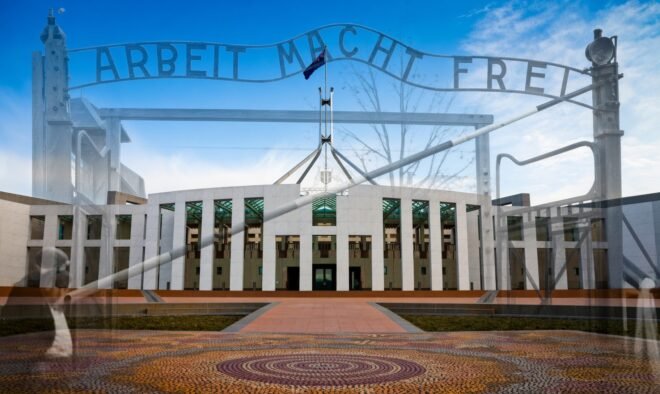
Two contemporary developments make the mechanism worth revisiting. In the United States, the second Trump administration has pressed claims of executive authority, over prosecutions and over the domestic deployment of the military, that the courts have been forced to adjudicate. In Australia, the Senate has just passed the Defence Legislation Amendment (Accelerating Capability and Protecting Bases) Bill 2026, which gives the executive new powers to displace ordinary law and to carve zones of special regulation out of the country’s land, sea and sky. The two cases are not equivalent, and the difference between them is where the instruction lies. The American record tests the ideological half of Fraenkel’s analysis: whether political alignment decides who receives the full protection of the law. The Australian bill tests the structural half: whether the power to draw the boundary of legality has been placed beyond effective review.
Two States in One Order
Fraenkel’s central insight was that Nazi Germany was neither lawless nor a straightforward expression of German legal tradition. It was doubled. A normative state continued to apply statutes, enforce contracts, prosecute ordinary crime and keep administration predictable, because a modern economy cannot run on chaos and the regime needed the economy. Beside it stood a prerogative state, answerable to nothing but political expediency and exercised by the Party, the Gestapo and ultimately the leader’s will. The normative state was never a liberal Rechtsstaat. It was a residue, tolerated for its usefulness.
What bound the two together was a power Fraenkel identified with precision: Kompetenz-Kompetenz, the authority to decide which matters belong to the ordinary legal order and which are declared political and therefore outside it. Once a matter received that designation, legal guarantees dissolved. Because the designating authority sat with the same people whose projects were at stake, the normative sphere shrank as more domains were reclassified. No court needed to be abolished and no code repealed. It was enough that the reach of those institutions had become conditional.
This is why the analysis travels. Its subject is not the swastika but the structure: a parallel track on which legal norms apply selectively, according to whether an actor or an issue is regarded as aligned with the governing project, and a threshold power, the decision over jurisdiction itself, that escapes independent review. Democracies possess counterweights that dictatorships lack, such as competitive elections, independent courts, a free press and organised opposition. But these are not automatic. They work only while the institutions charged with policing the boundary retain both formal independence and the practical capacity to enforce it. Fraenkel’s lesson is not that every democracy will slide into dictatorship, but that a single, non-contingent legal order is a continuous requirement rather than a settled inheritance. The question to put to any government is therefore twofold. On what criterion does it separate those who receive the law’s full protection from those who do not? And who, if anyone, can overrule it?
America: The Criterion of Alignment
The first half of that question is the American one. The administration’s critics argue that the second Trump term has introduced exactly the criterion Fraenkel feared, alignment with the governing project, into the decision about whom to prosecute. They point to a public directive from the President to his Attorney General to move swiftly against named rivals, and to the indictments of James Comey and Letitia James that followed. They note that Comey’s first indictment was dismissed because the prosecutor who brought it had been unlawfully appointed, that grand juries subsequently declined to re-indict James, and that career prosecutors reportedly cautioned against charging Comey at all. NBC News has reported that the circle of investigation widened to include a former presidential opponent, the chair of the Federal Reserve and a former cable television critic. Comey was indicted a second time in 2026, over a social media photograph of seashells arranged to spell “86 47”, which the Justice Department defends as a case about threats.
The administration and its defenders reply that none of this is what it seems. President Trump himself endured four criminal prosecutions, two of them initiated by the Biden Justice Department, and one of his first acts on returning to office was an executive order condemning a systematic campaign against perceived political opponents. On this account the current Justice Department is not introducing politics into prosecution but removing a politicised bureaucracy’s thumb from the scale. The record also contains cases that do not fit the critics’ template neatly. John Bolton’s indictment listed six federal attorneys who had recommended the charges, and an advocacy tracker reports that he pleaded guilty in June 2026. Not every prosecution of a Trump antagonist is therefore a sham, and even the administration’s sternest analysts concede that the occasional legitimate case must not be allowed to excuse the indefensible ones.
Fraenkel would have been less interested in motive than in pattern. The test of a dual state is not whether any single prosecution is justified but whether the criterion that selects cases for exceptional treatment is the target’s political position rather than the conduct alleged. A President who announces publicly whom he wishes to see prosecuted has supplied that criterion in his own words. Notably, however, the machinery has not simply obeyed. Judges have dismissed, grand juries have refused, and appellate courts remain in the path. The prerogative impulse is visible; the question is whether the normative order retains the power to resist it.
America: The Question of Reviewability
That question is answered most clearly in the domestic deployment of the National Guard, because here the executive claimed something close to Kompetenz-Kompetenz itself: the power to classify a situation as a rebellion, or as an inability to enforce federal law, and so to unlock exceptional force within the country. The courts declined to treat that classification as the executive’s alone. In December 2025 the Supreme Court left in place a ruling barring the administration from deploying the Guard in Illinois, over the dissents of Justices Alito and Thomas. In October this year a divided Ninth Circuit held that the deployment of four thousand California Guard members to Los Angeles was an unlawful abuse of authority, that the claim of rebellion fell outside the range of honest judgment, and, crucially, that a presidential decision to federalise the Guard is not insulated from judicial review. Earlier, Judge Charles Breyer had found that the administration wilfully broke federal law in that deployment, and Judge Karin Immergut, a Trump appointee, had blocked the Portland deployment after a trial.
These rulings matter because they defend precisely the boundary Fraenkel thought decisive. An executive that may declare an exception without review has a prerogative state; an executive whose declarations the judiciary may examine, and reject, has only a contested claim. The American courts have so far insisted on the second description. It would be a mistake, however, to read this as a settled victory. The rulings arrived long after the deployments they judged, the administration continues to appeal, and a boundary that must be re-defended in every case is a boundary under sustained pressure. What the American record shows is a legal order being tested and, so far, holding. It does not show one that is safe.
Australia: A Bill About Drones, and About Much More
Australia presents the inverse profile. There is no comparable pattern of publicly directed prosecutions, and the government’s stated purpose is modest and plausible: protecting Defence bases from drone incursions and replacing a patchwork of older security arrangements. The Defence Minister’s office says the bill follows a series of incursions at Australian bases and at comparable bases abroad. It was introduced on 27 October, referred to the Parliamentary Joint Committee on Defence, and cleared the Senate under a guillotine within weeks.
What alarms its critics is architecture. The bill creates a Defence Capability Framework under which capability declarations can exempt defined activities, assets and personnel from state, territory and some Commonwealth laws. The Canberra Times reports that these are to be made by non-parliamentary instrument, that the bill does not say which laws may be displaced, and that officials at the second-highest rank of the senior executive service and above could exercise the minister’s declaratory power, with twenty-four hours to inform the minister, who must ratify the declaration. The Australia Institute adds that declarations need not be made public. Read through Fraenkel’s lens, this is a power to decide, within the executive and sometimes out of sight, which domains of ordinary legality are switched off.
The second framework creates defence security zones. Defence’s own explanatory material describes permanent, temporary, mobile and special categories, and the minister may declare them over public or private land, sea, sky and even moving vehicles. Critics count dozens of new offences, many carrying strict or absolute liability, with penalties for incursion reaching seven years’ imprisonment and fines above $150,000. The Australia Institute argues that conviction for some offences would not require proof that the person knew a zone existed, which matters because some zones may not be publicly listed. “Defence security officials” would hold powers of detention, search and seizure, and the category could extend, the Canberra Times reports, to personnel of foreign militaries and to employees of arms manufacturers and technology companies. Review, on the critics’ account, is confined largely to permissions within zones. A weapons contractor disputing its conditions can seek it; a fisher, landholder or bushwalker affected by the same zone probably cannot. The bill reaches well beyond the Defence Act to more than a dozen other statutes, including freedom of information law and the law governing the National Anti-Corruption Commission.
A power to decide is only as safe as the hands that carry it out, and this is where the argument about structure meets my argument about the Federal Police. Defence’s own explanatory material says the enforcement powers in a zone are available to law enforcement officers and can be extended to defence security officials who are trained and authorised, and according to The New Daily, police will be given powers to patrol the special zones. The Federal Police are not singled out, but they plainly fall within the wider definition of police on which those powers rest. The argument does not depend on them in particular. The bill entrusts new powers of detention, search and seizure to officers who will operate in zones that may not be publicly listed, enforcing offences that may not require proof the person knew a zone existed, with review largely confined to permissions within the zone. Fraenkel’s prerogative state was never only a set of unreviewable decisions. It was those decisions together with an apparatus willing to enforce them without asking whether they were lawful. Whether the Federal Police would behave in that way is a question of conduct, to be answered by evidence, and I will take it up in a separate post. That the design of the bill leaves so little room for anyone else to ask the question is a matter of structure, and it can be judged on the text alone.
Process compounds substance. Experts told the Canberra Times they had not had time to read a bill of this complexity. The joint committee, composed only of Labor and Coalition members, closed submissions after five days with ten received, four of them apparently withheld from publication. An academic at the ANU’s National Security College observed that Australia has no federal charter of rights to limit such powers, and read the bill as a step towards preparedness for armed conflict in the region. Independent senator David Pocock and the Greens’ David Shoebridge denounced it in the strongest terms. Labor and the Coalition, joined by One Nation, carried it.
The Case for the Bill, and the Limits of the Analogy
The government’s case deserves its full weight. Assistant Minister Peter Khalil, who introduced the bill, says it is about protecting personnel, critical infrastructure and sensitive capabilities, not about protesters. Defence’s explanatory material says zones may be established only in the circumstances and for the purposes the legislation prescribes, that measures must be reasonably necessary for defence security purposes, and that the bill is not AUKUS-specific legislation. Khalil has rejected claims that data centres or general industry sites could be routinely declared zones, and has accused critics of inaccuracy, a charge Shoebridge disputes point by point. Oversight, the government says, lies with the Inspector-General of the Australian Defence Force and the parliamentary committee, and Parliament may disallow delegated legislation. Drone incursions at sensitive facilities are real, and a defence force unable to respond to them lawfully has a genuine problem. Several of the sharpest critiques, moreover, come from advocacy organisations, and a bill’s text is a better guide than any summary of it, this essay’s included.
Yet the oversight the government cites is exactly what Fraenkel would have scrutinised. The Canberra Times reports that the minister may withhold information from Parliament if disclosure could endanger national security, leaving the Inspector-General as the sole avenue of review in those cases. Scrutiny by an official within the defence establishment, of declarations Parliament may not be shown, is review of a kind. It is not the independent review that makes a boundary non-contingent.
The analogy must also be bounded honestly. Fraenkel’s prerogative state ran on an ideological criterion: racial enemy status determined who was exposed to arbitrary power. Nothing in the Australian bill selects by belief, identity or political alignment, and its backing across the major parties reflects a shared security rationale rather than a governing ideology. The danger it poses is potential rather than demonstrated. But potential is what structure is for. A prerogative sphere does not announce itself with its first use. It is built in advance, under a respectable rationale, as a capacity awaiting a purpose. The relevant question is not whether this government will abuse the capacity, but what the next one, facing a different emergency or a more inconvenient protest, will find on the shelf.
Conduct and Design
Set side by side, the two cases reveal Fraenkel’s twin warnings. America offers a lesson in conduct: leadership willing, on the evidence its critics assemble, to let political alignment shape who is pursued, checked so far by judges, grand juries and a federal system that has refused to treat the executive’s declarations as self-validating. Australia offers a lesson in design: a statute without ideological animus that nonetheless places a significant power to define the reach of ordinary law, and to enforce it, in the executive, with review limited and some of its exercise potentially hidden. The first is a danger that depends on persons. The second is a danger that outlasts them. Conduct can be corrected at an election; architecture can only be repealed.
The remedies Fraenkel’s analysis suggests are not exotic. Declarations and zone designations should be published or, where secrecy is genuinely required, reported to a body with the independence to examine them. The laws displaced by a capability declaration should be listed rather than left to executive discretion. Landholders, fishers and others affected by a zone should have a right to seek review of the zone itself, not merely of permissions within it. And the first prosecution under the new offences, whether of a photographer or a protester, will say more about the character of the arrangement than any explanatory memorandum.
In America, the courts are asked to hold the line against an executive reaching for the power to say what is political. In Australia, the line itself has been drawn thinly. Neither country is Weimar’s heir, and Fraenkel would have been the first to say so. His warning was more modest and more durable: that legality can survive in form long after it has ceased to govern the cases that matter, that the first sign is seldom a closed court but a boundary quietly made conditional, and that the only defence is to insist, repeatedly and before it is needed, on a single law that does not reserve to itself the power to declare its own rules inapplicable.
– – –
Bakchos is the founder of Blak and Black, an Australian media and advocacy platform established in 2010. Bakchos writes from the intersecting perspectives of Wiradjuri heritage, Jewish identity, and humanism.
© Bakchos, November 2026