Settler cinema, political myth and the Indigenous counter-narrative
Simon Schama, reflecting on the film adaptation of a work by Sir Walter Scott, observed that the tragedy is not only that history is rewritten and transformed, but that a nation’s people absorb and believe the history that is presented in novels and movies instead of the actual history. This insight applies with particular force to Australian cinema’s long engagement with the colonial past, and it continues to resonate in contemporary politics. From the silent era through the mid-twentieth century and into the New Wave, films repeatedly rewrote the processes of settlement, dispossession, and frontier conflict. They offered narratives of empty or conquerable land, heroic pioneering, assimilationist duty, or tragic racial destiny that audiences absorbed as national self-understanding. The actual history – of organised resistance, massacres, land seizure under terra nullius, the Stolen Generations, and structural exploitation – was subordinated or romanticised. Even films that sought to confront this past, such as The Chant of Jimmie Blacksmith, performed their own transformations. The absorbed versions of an Australia that never quite existed have since been mobilised by populist politicians, most prominently Pauline Hanson, who treat those myths as self-evident national fact.
The tragedy Schama identified is not merely that history is rewritten. Every generation rewrites its past, and some of that rewriting is honest work, the slow correction of the record as new evidence and new voices arrive. The tragedy is that the rewritten version is absorbed as the real thing. It passes out of the hands of the people who made it and into the common sense of a nation, where it is no longer an argument that can be answered but a background assumption that nobody remembers having agreed to. A people who have absorbed an invented past do not experience it as invention. They experience it as memory.
In Australia this process has had a particular and traceable history, and a great deal of it was carried by the screen. Settler cinema and the political myths that continue to draw on it have long performed exactly this substitution: the continent as empty or lightly occupied, colonisation as pioneering enterprise rather than invasion and dispossession, and Indigenous people as either vanishing, assimilable, or incidental to the national story. These were not only the preoccupations of a few propagandists. They were the grammar of images that Australians grew up watching, and an image that is watched often enough, from childhood, in the dark, alongside everyone else, acquires an authority that no footnote can match.
Indigenous filmmakers have spent the past four decades producing counter-narratives that refuse that substitution. Their work does not simply correct the record, which would be a necessary but limited task, since a correction can be read and set aside by anyone who prefers the older version. It does something harder. It makes other histories and other presents vivid enough to interrupt the process of absorption itself. This essay traces that conflict: first the cinema that laid down the myth of the empty land, then the political rhetoric that inherited it, and finally the Indigenous films that have contested it at the level where it was built, which is the level of the image, the language and the question of who is permitted to author the story.
The Foundations of an Empty Screen
Mid-twentieth-century Australian cinema was largely built on the ideological foundations of terra nullius and the White Australia policy. The doctrine of terra nullius, the legal fiction that the continent belonged to no one at the moment of British claim, was not merely a rule of property law. It was a story about what kind of people had lived here and what kind of relationship they had with the land, a story in which Aboriginal societies were too mobile, too undeveloped or too sparse to count as owners. The White Australia policy supplied the complementary story about the future, in which the nation would be a settled outpost of a single people. Cinema was a natural instrument for both, because it could show them rather than argue them. It could place a landscape on screen and simply leave it empty.
The silent-era epic The Birth of White Australia (1928) is the plainest example. It staged Federation as a white racial triumph, treating the creation of the Commonwealth as the culmination of a racial destiny rather than as an arrangement made among colonies that had themselves been established on land taken from others. The title does not hide its premise. Its Australia is born at the moment it becomes white, and whatever came before is prehistory.
The Ealing Studios productions of the late 1940s and early 1950s were more polished and, for that reason, more effective. The Overlanders, Bitter Springs and Eureka Stockade recycled the formula of the empty or contestable outback waiting for white enterprise. The drovers, the pastoralists and the diggers of these films are brave, resourceful and decent, and the land they cross is a test of character rather than a place already full of law, kinship and obligation. A viewer who absorbed these films learned, without being told, that the continent had been waiting. The outback was a stage, and the people who had walked it for tens of thousands of years were either off it or at its margins.
Even when these films registered Aboriginal presence, as The Overlanders did, the narrative frame remained the legitimacy of settlement. The drama is organised around the settlers’ difficulties, with Aboriginal people appearing as an obstacle, a complication, and eventually a presence to be accommodated. To acknowledge that people were there is not the same as acknowledging that the land was theirs. The film could depict the first while taking for granted that the second was not in question.
The recent recovery of the improvised dialogue spoken by Anangu actors in that film, who were told simply to “talk,” is revealing for precisely this reason. What the Anangu actors said, in their own language, was not part of the script and was not understood by the producers or the white cast. It has now been recovered, and it reveals a second, unheard story of displacement and refusal running beneath the official script. The soundtrack of the film contained a counter-narrative from the beginning, delivered in front of the cameras and the crew, and nobody involved in the production could hear it. The producers and white cast did not understand it; the audience was not meant to. There is hardly a better emblem of the whole problem. The Aboriginal voice was present, was recorded, and was made inaudible by the simple fact that nobody with authority over the film needed to know what it said.
Jedda and the Making of a Tragedy
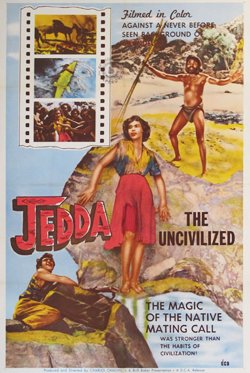
Jedda (1955) is the most sophisticated and most enduring of these works, and it deserves to be taken seriously on its own terms. Charles Chauvel’s melodrama about an Aboriginal girl raised by a white station couple offered the first substantial roles for Aboriginal actors in an Australian feature and treated the “Aboriginal problem” as a national subject. It was shot in colour, in the Northern Territory, with a visual ambition that has kept it in circulation for seventy years. Its lead performers, Ngarla Kunoth and Robert Tudawali, gave it a presence that its script did not always earn. Any honest account of Australian cinema has to acknowledge that the film was a landmark, and that for many Aboriginal viewers it was also among the first times they had seen people like themselves on a cinema screen.
Yet its structure is assimilationist tragedy. Jedda is torn between the white world that has raised her and the “tribal” man who abducts her, and both she and her abductor die. The film presents these as the only two available destinies and then destroys both. She cannot be absorbed into the household that raised her, since the film never allows her to forget that she is Aboriginal, and she cannot return to the culture she was removed from, since the film treats that culture as a danger and a seduction. The only exit is the cliff.
Marcia Langton has argued that the film rewrites resistance as self-destruction, converting the historical fact of Aboriginal refusal into a story of inevitable failure to enter modernity. This is the crux of the matter. The historical record of the pastoral frontier and the mission system is not a record of passive disappearance. It is a record of strikes, of flight from stations, of the maintenance of language and ceremony under conditions designed to extinguish both, of people declining on a thousand occasions to become what the policy of assimilation required them to become. Jedda takes that refusal and gives it a plot in which refusing is fatal. The viewer is invited to feel sorrow at the death of the girl and her pursuer, and the sorrow itself does the ideological work. If the outcome is tragic, it is also natural; if it is natural, nobody in particular is responsible.
The visual rhetoric supports the story. The outback appears as sublime emptiness, vast and beautiful and indifferent. Aboriginal culture is staged as both alluring and doomed, a thing to be admired in the way one admires something that is about to be lost. The final cliff-fall, with the two figures going over together, seals the argument. All of these devices serve the same end: history is rewritten so that the coloniser’s project appears both tragic and necessary. It is tragic because something beautiful is lost, and necessary because the loss cannot be avoided. That is a far more durable form of apology than denial, because it allows the audience to feel sympathy without feeling implicated.
Jimmie Blacksmith and the Limits of the Sympathetic Gaze
Fred Schepisi’s The Chant of Jimmie Blacksmith (1978) marked a decisive break in subject matter while remaining inside a settler visual language. Based on Thomas Keneally’s novel about the 1900 killings by Jimmy Governor, the film refuses the consolation of pioneer innocence. Its protagonist is an Aboriginal man of mixed descent who internalises the promises of assimilation, works hard, seeks respectability and a place within white society, and is cheated, humiliated and exploited until he turns to killing. The film does not treat the white families who suffer his violence as villains, but neither does it allow the audience to suppose that his violence came from nowhere. It had a cause, and the cause was the gap between what the settler society promised and what it delivered.
Schepisi and cinematographer Ian Baker use the 2.35:1 Panavision frame to place human figures against vast landscapes that do not welcome them. Where Jedda had offered the outback as sublime, this film offers it as a space of exposure. Fences, interiors and extreme long shots repeatedly emphasise enclosure and exposure, and the people in the frame look small, cornered and watched. The violence is filmed with an objective coldness that shifts, at moments of killing, toward a more subjective and expressionist register, as though the film itself were losing its composure.
The result is a film that acknowledges frontier atrocity yet still frames that atrocity through the eyes of a white director looking at an Aboriginal protagonist whose rage is both justified and monstrous. That formula, justified and monstrous at once, is the film’s real subject and also its limit. It is a powerful critique of the assimilationist promise, and it demolishes the comfortable idea that the frontier was a story of opportunity. But it is not yet an Indigenous narrative of that history. The perspective from which we see Jimmie is sympathetic, even anguished, but it is still the perspective of someone looking at him. The film asks what the settler society did to Jimmie. It does not ask what Jimmie’s people, with their own law and their own memory, would have said about the whole affair. That question would have to be asked by others.
The Afterlife of the Myth
The images laid down by this cinema did not stay in the cinema. They moved into political speech, where they could be invoked without being named. The political myth-making that has accompanied and outlived this cinema is most clearly visible in the rhetoric of Pauline Hanson and sections of the contemporary populist right. The claim that Australia was “nothing” before European arrival, that Aboriginal societies “achieved nothing” because they did not invent the wheel, that Native Title is a threat to ordinary Australians, and that a single monocultural story is the only legitimate national memory are not new inventions. They are the political afterlife of the empty-land and dying-race images that cinema helped naturalise.
Consider the structure of the claim that Aboriginal societies achieved nothing because they did not invent the wheel. It has the form of an empirical observation, but it is really an assumption about what counts as an achievement, and the assumption is borrowed wholesale from a narrative of progress in which technology and the accumulation of material goods are the measures of civilisation. By that measure, societies that sustained a continent’s ecology, maintained complex systems of kinship and law across hundreds of generations, and preserved an oral record of events stretching back to the end of the last ice age achieved nothing at all. The claim only seems plausible to an audience that has already been taught, through a thousand images of empty landscape, that nothing was there.
The same is true of the political hostility to Native Title. If the land was empty, then a claim that someone owned it is a kind of imposition, a special privilege asserted against the interests of ordinary people. If the land was full, then the claim is simply the belated recognition of a prior right, and the hostility has to be explained in other terms. Which of the two pictures a citizen carries decides, almost before any argument begins, how the claim will sound.
Schama’s point applies directly. Once a population has absorbed the cinematic and literary version of its past, politicians can invoke that version as common sense. They do not need to prove it, because their audience already believes it, and the belief feels like experience rather than instruction. The “Australia that never existed”, with its peaceful settlement, its grateful or vanishing natives and its frontier of opportunity rather than war, becomes the standard against which Indigenous claims appear as special pleading or historical revisionism. The inversion is complete. The people who are recovering the record are accused of rewriting it, and the people who rewrote it are defending the truth.
This is why a purely documentary response, however necessary, is never sufficient. A footnote can establish that a massacre occurred. It cannot dislodge an image of an empty landscape that a person has carried since childhood. The myth was built from pictures and stories, and it can only be seriously contested by pictures and stories of at least equal vividness.
Interrupting the Circuit
Indigenous counter-narratives interrupt this circuit at the level of image, language and authorship. They change what is shown, in what language it is spoken, and who stands behind the camera. Each of these shifts matters, and the strongest films make all three at once.
Tracey Moffatt’s Night Cries: A Rural Tragedy (1990) is the most explicit reply to Jedda. Shot entirely in a constructed studio with almost no dialogue, it imagines Jedda as a middle-aged woman caring for her dying white foster mother. The artificiality is deliberate. Where Chauvel had gone to the Northern Territory to film an outback of sublime emptiness, Moffatt builds her landscape out of painted backdrops and stage lighting, declaring that this is a constructed image and always was. The film recycles visual and sonic motifs from Chauvel, including the cry of mother and child, while inverting the relation of power and exposing the domestic afterlife of assimilation.
What the film shows is the other half of the story that Jedda had cut short. The girl who is raised in a white household does not die on a cliff. She grows old, and she is still there, performing the labour of care for the woman who took her. Care and resentment coexist; belonging is impossible in either world. The daughter is bound to her foster mother by years of intimacy and by obligation, and also by the knowledge of what was taken to make that intimacy possible. Neither feeling cancels the other, and the film refuses to resolve them.
By refusing the naturalist outback and the tragic cliff-fall, Moffatt denies the spectator the consoling ending that Jedda had offered for decades. There is no dramatic death to weep over and move on from. There is only the long, undramatic persistence of a damaged relationship, which is closer to the actual history of removal than any tragedy of extinction. The effect is to take away the audience’s permission to feel finished.
Warwick Thornton’s work extends the same refusal into both contemporary and historical registers. Samson and Delilah (2009) observes two teenagers in a remote Central Australian community with a near-silent attention that refuses rescue narratives or sociological uplift. The film does not offer the viewer a social worker’s viewpoint, a diagnosis, or a program that might fix what is wrong. It watches two young people endure poverty, neglect, violence and the indifference of the wider country, and it watches them look after each other. It won the Caméra d’Or at Cannes in 2009, and it has been much discussed for its restraint.
Thornton’s insistence that the characters must live is itself a political act against the long tradition of Aboriginal death as narrative resolution. From Jedda onwards, the Aboriginal character who threatens the settler order, or who simply cannot be accommodated by it, has tended to die at the end, and the audience has been invited to find this fitting. In refusing that ending, Thornton denies cinema one of its oldest ways of closing the book on the Indigenous presence. His characters survive, and their survival is not a reward or a consolation but a fact.
Sweet Country (2017), a revisionist Western set in 1929 and based on a real case of self-defence, treats the landscape as already known and occupied by its Aboriginal protagonists. The film follows an Aboriginal stockman who kills a white man in self-defence and flees into the desert with his wife, pursued by a posse. The genre is familiar, but its usual pleasures are withheld. The film tracks the consequences of treating Black labour as free and Black bodies as available, then withholds the cathartic shoot-out of the classical Western. In the classic form, the violence resolves the tension and the audience goes home satisfied that order has been restored. Thornton declines to give that satisfaction. What remains is the law, with its procedures and its prejudices, and the viewer sees exactly how it operates.
Its visual language, Thornton’s own cinematography, makes Country a subject rather than a backdrop, reversing the Heidelberg-inflected emptiness of earlier settler cinema. The landscape of the Heidelberg painters and their cinematic heirs was a space waiting to be inhabited. In Sweet Country the same wide horizons and the same light are there, but they now belong to people who know every feature of them, who read the ground and the water and the weather, and who move through it as their home. The beauty has not been removed. It has been returned to its owners. The result is a history that cannot be absorbed as pioneering adventure.
Country, Law and the Present Tense
Ivan Sen’s Mystery Road cycle relocates the Western and noir traditions into the present, where mining, policing and residual colonial attitudes continue to alienate Aboriginal people from land and from justice. The detective at the centre of these films moves between two worlds and is fully trusted in neither, and the crimes he investigates are tied to the economic exploitation of country and the casual disregard for Aboriginal lives that persists in institutions long after their formal policies have changed. Dialogue and framing repeatedly evoke the lingering logic of terra nullius, the idea that a place was “nothing” until white economic activity arrived, while the Indigenous characters’ knowledge of Country undercuts it. The empty land of the old myth is not a historical curiosity, but the working assumption of a mining company or a police station in the present day.
Rachel Perkins has worked across documentary and feature forms, and the two bodies of work illuminate each other. Her documentaries First Australians (2008) and The Australian Wars (2022) compile oral, archival and expert testimony that treats frontier conflict as war rather than “skirmish,” and that includes Perkins’s own family’s history of massacre. The vocabulary matters. A skirmish is a minor incident, a disturbance in an otherwise peaceful process of settlement. A war is a sustained conflict between parties with competing claims, and to call the frontier a war is to concede that the other party had a claim worth fighting for. The Australian Wars brings that argument into the open, using the colonial record itself as evidence, and the effect is to make the empty-land myth very hard to maintain.
Her feature Radiance (1998) and the musical Bran Nue Dae (2009) explore the afterlives of removal and mission education from inside Aboriginal kinship and humour. Here the strategy is different. Instead of confronting the myth directly, these films simply occupy the space it denied, showing families, jokes, quarrels, songs and loyalties that are intelligible without reference to the settler gaze. Humour is itself a form of authority. To be able to laugh at the mission, the priest and the policy is to show that the institutions that were meant to remake a people did not succeed in doing so.
Leah Purcell’s The Drover’s Wife: The Legend of Molly Johnson (2021) rewrites Henry Lawson’s canonical short story so that Aboriginal law and experience are no longer absent from a foundational settler text. Lawson’s story, with its lone white woman defending her children against the bush, became one of the founding images of Australian endurance, and the Aboriginal people who lived in and around the landscape it describes are largely absent from it. Purcell’s version restores them, and in doing so reveals how much the original depended on their absence. This is the counter-narrative at its most direct, because it enters the canon and alters it from within, so that a reader or viewer can no longer return to the older text without knowing what it left out.
A World That Was Always Full
Collaborative works such as Ten Canoes (2006) push the counter-narrative further by refusing the colonial encounter altogether. Spoken primarily in Yolngu Matha languages and co-directed with the Ramingining community, it is the first feature-length Australian film made entirely in Indigenous languages and the first set wholly in a pre-colonial period. The significance of that formulation is easy to miss. Every other film discussed in this essay, however critical, is in some sense a response to the arrival of the settlers. They are about contact, conflict, removal, assimilation or the long aftermath. Ten Canoes is not about any of those things. It is about a community with its own stories, its own disputes and its own law, and it does not wait for Europeans to give it a plot.
Nested storytelling, law, humour and detailed knowledge of Country present a self-contained world that does not require European arrival to be complete. The film tells one story within another, in a manner that follows Yolngu conventions of telling rather than the structure of a Hollywood feature. The comedy is not decorative. It carries the social relations, the tensions between older and younger men, the rules of kinship and the penalties for breaking them. A viewer comes away with the unmistakable sense of a society that was fully formed, intricate and self-governing, long before any ship appeared on the horizon.
The film’s existence is itself an argument against the absorption of the empty-land myth: here is a history that was always already full. Where the settler films had to argue, or assume, that the land was empty, this film does not argue at all. It simply fills the frame, in a language the settlers did not speak, with people the settlers did not see, and lets the myth collapse by default. There is no need to refute the claim that nothing was there when the screen is so evidently crowded.
The Unfinished Work
These works do not form a single aesthetic or political programme. Some are experimental, some classical, some collaborative, some fiercely independent. Moffatt works in the stylised space of the studio, Thornton in the long take and the open landscape, Perkins in the archive and the ensemble, Purcell in the revision of a canonical text, and the Ramingining collaborators in a mode that owes more to Yolngu storytelling than to any cinematic tradition. Their disagreements, formal and political, are real, and nothing is gained by flattening them into a movement with a single manifesto.
What they share is a determination to make histories and presents that cannot be easily absorbed into the pioneer narrative. They restore language, agency, kinship and Country to the centre of the frame. They treat the frontier as war and its aftermath as structure rather than event. The distinction is important. An event can be mourned and left behind. A structure persists, in the ownership of land, in the operation of police, in the allocation of resources and in the stories that a country tells about itself, and it has to be addressed in the present tense.
In doing so, they make Schama’s tragedy harder to complete. The rewritten history can still be believed, and populist politicians continue to offer it as common sense. Nothing in this body of work guarantees that the myth will fall, and it would be naive to suppose that a film, however accomplished, can undo a century of accumulated images. But it can no longer be the only history that is vividly, repeatedly and authoritatively visible. A child who grows up watching Samson and Delilah or Sweet Country or Ten Canoes is no longer in the position of a child who saw only the outback of Ealing and the cliff of Jedda, and the difference is not trivial.
The gap between what has been widely seen and what Indigenous filmmakers have shown remains the measure of that unfinished work. It is a gap in audiences, in funding, in the attention of schools and broadcasters, and in the willingness of political leaders to take these histories as seriously as they take the older story. The task is not only to make more films, though that matters, but to ensure that the histories they show become part of what the country absorbs as its own. Absorption is the mechanism by which a false past becomes a common one. The work now is to make sure it can also carry a true one.
– – –
Bakchos is the founder of Blak and Black, an Australian media and advocacy platform established in 2010. Bakchos writes from the intersecting perspectives of Wiradjuri heritage, Jewish identity, and humanism.
© Bakchos, November 2026