
“What passing-bells for these who die as cattle?
Only the monstrous anger of the guns.”
~Wilfred Owen, “Anthem for Doomed Youth” (1917)~
I. Into the Charnel House
In the shadowed crucible of the First World War, where the relentless grind of industrial slaughter transformed Europe’s fields into charnel houses of mud, wire, and uncounted dead, there burned faint yet unquenchable sparks of humanity. The war that erupted in 1914 was unlike any before it: a mechanised apocalypse of machine guns that spat death at rates unimaginable to earlier generations, artillery barrages that pulverised landscapes and men alike, trenches festering with rats and disease, and the creeping horror of poison gas that turned breath itself into torment.
By the time the guns finally fell silent in November 1918, over sixteen million souls had perished — entire generations of young men from Britain, Germany, France, and beyond reduced to names on memorials or unmarked graves in no-man’s-land. It was a conflict born of empires, fuelled by nationalism, and prosecuted with the cold efficiency of factories churning out shells, rifles, and barbed wire. It mechanised death as surely as it mechanised manufacture; it industrialised grief as efficiently as it industrialised mud.
Yet in this darkest of days, amid the industrial-scale horror that seemed to strip away every vestige of civilisation, ordinary men — and even some leaders — revealed a profound, unbreakable core of decency, honour, and brotherhood. Two luminous examples stand out as beacons of enduring hope: the extraordinary story of British Captain Robert Campbell, who honoured a promise to his enemy emperor at the cost of his own freedom, and the numerous Christmas truces of 1914 and their quieter echoes in later years, when soldiers from opposing sides laid down their arms to embrace one another as fellow human beings.
“In Flanders fields the poppies blow
Between the crosses, row on row,
That mark our place; and in the sky
The larks, still bravely singing, fly
Scarce heard amid the guns below.”
~John McCrae, “In Flanders Fields” (1915)~
These were not grand political gestures or calculated strategies. They were raw, spontaneous affirmations that even in the abyss of total war, the human spirit refuses to be extinguished. They remind us that compassion, integrity, and shared frailty can pierce the densest fog of enmity. They affirm that the better angels of our nature — to borrow Lincoln’s resonant phrase — cannot be silenced by shells or strangled by barbed wire.
II. The Darkness That Made the Light
To truly appreciate these sparks, one must first confront the unrelenting darkness they illuminated. World War I was the first truly industrialised conflict in human history. Soldiers lived like moles in waterlogged trenches, where frostbite claimed toes as readily as bullets claimed lives. The Battle of the Somme alone, in 1916, produced 1.2 million casualties in a single campaign that advanced the front by mere miles. Poison gas, introduced at Ypres in 1915, blinded and choked men in agonising slow motion. Machine guns mowed down charging infantry with mechanical indifference.
And the psychological toll was incalculable: shell shock — now recognised as severe combat trauma — shattered minds as surely as shrapnel shattered bodies. Commanders on both sides, far from the front lines, issued orders that treated soldiers as expendable cogs in a vast killing machine. Propaganda painted the enemy as subhuman monsters. Beneath the helmets and khaki, or feldgrau, beat hearts that yearned for home, for family, for an end to the dying.
“Bent double, like old beggars under sacks,
Knock-kneed, coughing like hags, we cursed through sludge,
Till on the haunting flares we turned our backs
And towards our distant rest began to trudge.”
~Wilfred Owen, “Dulce et Decorum Est” (1917)~
It is precisely against this backdrop — of mud and machine and mechanised despair — that Captain Campbell’s act and the Christmas truces shine so brightly. Not as anomalies that disprove the war’s brutality, but as proof that humanity’s better angels could still take flight, however briefly, in the face of mechanised horror. They were small, personal victories of the soul over the system. They remind every generation since that war does not define us; our capacity for empathy does.
III. A Captain’s Word — Robert Campbell and the Emperor’s Mercy
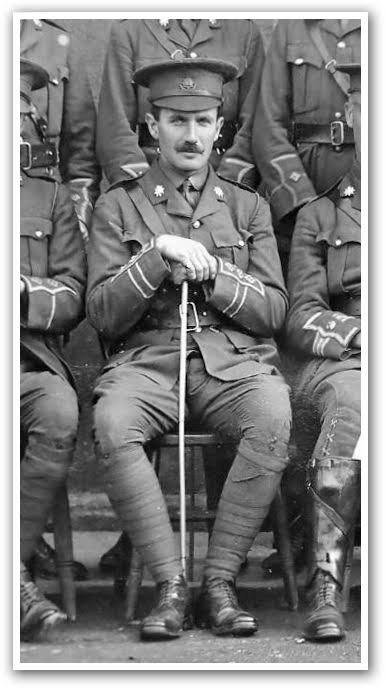
The story of Captain Robert Campbell begins in the war’s chaotic opening weeks — a tale of capture, desperation, imperial mercy, and unbreakable honour that feels almost mythic in its purity. Born in 1885, Campbell was a professional soldier commissioned into the British Army in 1903, rising to captain in the 1st Battalion of the East Surrey Regiment by the outbreak of hostilities. Just weeks into the war, on 24 August 1914, during the desperate fighting along the Mons-Condé canal in northern France, he was severely wounded during the Battle of Mons and captured. At only twenty-nine years old, he found himself a prisoner of war, transported to a hospital in Cologne for treatment and then to the sprawling Magdeburg prisoner-of-war camp in northeast Germany.
For two long, soul-crushing years, Campbell languished there, cut off from news of home, enduring the monotony, deprivation, and uncertainty that defined prisoner life. Then, in late 1916, devastating news arrived via a Red Cross letter: his beloved mother, Louise Campbell, back in the family home in Gravesend, Kent, was dying of cancer. The prognosis was grim; she had little time left. In an era of slow communication and ironclad borders, the distance felt insurmountable.
“Stone walls do not a prison make,
Nor iron bars a cage,
Minds innocent and quiet take
That for an hermitage.”
~Richard Lovelace, “To Althea, from Prison” (1642)~
Campbell’s mind was not idle, nor his spirit caged. Driven by filial love and a touch of audacious hope, he took a step that defies logic: he penned a personal letter directly to Kaiser Wilhelm II, the German Emperor himself, begging for compassionate leave — just long enough to bid his mother farewell. It was a wildly improbable request. The Kaiser was the supreme warlord of Germany, architect of a conflict that had already claimed hundreds of thousands of lives. Why would he entertain the plea of a lowly enemy captain?
Yet astonishingly, the Kaiser read the letter and granted the request. Campbell would receive two weeks of leave — including travel time — but on one ironclad condition: he must give his solemn word as a British officer that he would voluntarily return to the Magdeburg camp once the fortnight ended. No guards, no escort — just his honour as bond.
The journey home was itself an odyssey through war-torn Europe. Campbell travelled by train and boat, routing through neutral Netherlands, crossing the Channel to reach England. He spent a precious week at his mother’s bedside — tender conversations, shared memories, the quiet comfort only a son can provide a dying parent. Louise passed away in February 1917, but Campbell had been granted the gift of presence in her final days: a mercy few wartime families received.
“Do not go gentle into that good night,
Old age should burn and rave at close of day:
Rage, rage against the dying of the light.”
~Dylan Thomas, “Do Not Go Gentle into That Good Night” (1947)~
Louise Campbell did not rage; she was comforted. And with his time expired and his heart heavy, Campbell did the truly extraordinary: he kissed his remaining family goodbye, packed his bags, and retraced his steps across the war zone. True to his word, he walked straight back into the Magdeburg camp and presented himself to the commandant. “I have returned,” he reportedly said simply. The German officer, visibly moved, shook his hand in reply: “I knew you would.”
Word of this act spread like wildfire among prisoners and guards alike. It was unprecedented — historians note it as the only recorded instance of a British prisoner of war receiving such compassionate parole during the entire conflict. For comparison, Britain itself denied a similar request from a German prisoner, Peter Gastreich, held on the Isle of Man. Campbell’s choice was not born of coercion but of an inner code that placed honour above personal liberty. He was, in every essential sense, free already: free because his integrity was intact.
Back in captivity, Campbell did not lapse into resignation. As a British officer he felt a parallel duty to attempt escape. He joined a group of fellow prisoners in a daring nine-month tunnelling project. They emerged near the Dutch border but were recaptured and returned to Magdeburg. He remained imprisoned until the Armistice in November 1918 finally set him free. He continued serving with the East Surreys until 1925, rejoined the colours in the Second World War as chief observer for the Royal Observer Corps on the Isle of Wight, and lived a full life until his death in July 1966, aged eighty-one.
“This above all: to thine own self be true,
And it must follow, as the night the day:
Thou canst not then be false to any man.”
~William Shakespeare, Hamlet, Act I, Scene iii~
Campbell’s story is Shakespeare’s counsel made flesh. In the industrial slaughterhouse of 1916, when the Somme raged and millions suffered, this quiet exchange between enemies stood as proof that empathy could transcend trenches and titles alike. The Kaiser’s unexpected compassion reveals a flicker of humanity at the highest levels of power — a reminder that even emperors could be moved by a mother’s plight and a soldier’s plea. Campbell’s return was not weakness; it was strength of a rare and enduring kind: the strength of a man who understood that true freedom lies in integrity.
IV. Silent Night, Holy Night — The Christmas Truces
If Campbell’s saga represents an individual spark of honour piercing the darkness, the Christmas truces of World War I illuminate a collective one: tens of thousands of ordinary soldiers, acting entirely on their own initiative, choosing peace over slaughter for a fleeting but transcendent holiday. The most famous — and most widespread — occurred in December 1914, just five months into the war, when the fighting had already hardened into the horror of trench warfare. Pope Benedict XV had called for an official Christmas ceasefire, but the warring governments dismissed it. No matter; the soldiers took matters into their own hands.
Along roughly two-thirds of the 30-mile British-held sector of the Western Front — and in isolated pockets involving French and Belgian troops — unofficial ceasefires erupted spontaneously. Estimates suggest up to 100,000 men participated across dozens of separate truces. It was not one grand armistice but a mosaic of local miracles, each born from the same elemental human impulse: the refusal to let hatred have the final word.
“I heard the bells on Christmas Day
Their old, familiar carols play,
And wild and sweet
The words repeat
Of peace on earth, good-will to men!”
~Henry Wadsworth Longfellow, “Christmas Bells” (1865)~
Longfellow composed those lines during the American Civil War, in a year of personal anguish, straining to hear hope beneath the thunder of guns. Half a century later, across the churned fields of Flanders, men heard those bells again — not in cathedral towers but in the voices of enemies singing softly across no-man’s-land. The magic began on Christmas Eve. German troops — many of them reservists with families back home — began decorating their trenches. Small fir trees, adorned with candles and lanterns, were hoisted above the parapets. Then came the singing: haunting renditions of Stille Nacht drifting across the wasteland of wire and shell craters and unburied dead.
British soldiers huddled in their own trenches, clutching plum puddings from home, listened in astonishment. Some responded with carols of their own. Shouts echoed: “Merry Christmas, Tommy!” “Merry Christmas, Fritz!” White flags fluttered. And then, tentatively at first, men climbed out of their trenches. Rifles were left behind. Hands were extended across a strip of frozen earth that had been a killing ground only hours before.
What followed defies the grim narrative of the war entirely. In sector after sector — at Ploegsteert in Belgium, near Ypres, along the La Bassée canal — soldiers met in the middle of no-man’s-land. They exchanged gifts: British cigarettes for German sausages and beer; chocolate for tobacco; cap badges and uniform buttons as keepsakes. They shared family photographs, showing sweethearts and children to the men they were ordered to kill. Haircuts were given; impromptu barbershops flourished in the frozen mud. Joint burial parties formed, with chaplains from both sides conducting simple services over the fallen.
“What are the bugles blowin’ for?” said Files-on-Parade.
“To turn you out, to turn you out”, the Colour-Sergeant said.
“What makes you look so white, so white?” said Files-on-Parade.
“I’m dreadin’ what I’ve got to watch”, the Colour-Sergeant said.”
~Rudyard Kipling, “Danny Deever” (1890)~
Kipling knew the terrible weight of military duty and the cost of watching men die by order. But on Christmas Day 1914, soldiers briefly set down that weight. They played football in no-man’s-land, using tin cans or bundled cloth for balls, with goals marked by caps or helmets. A British soldier wrote home: “There was not an atom of hate on either side that day.” Captain Jack Armes of the North Staffordshire Regiment described it in a letter to his wife as “one of the most extraordinary scenes imaginable.” Private James Davie of the Seaforths recalled Germans emerging with white flags, offering tobacco, showing photographs of their wives, agreeing not to fire for the day. “We kept our word,” he marvelled; “there wasn’t a shot fired.”
These truces were numerous precisely because they arose organically across the front. In some British sectors opposite Saxon German units — who spoke English and shared cultural ties — the fraternisation was especially warm and prolonged, lasting into Boxing Day or even New Year’s. Not every inch of the line participated; in some places, fighting raged on. But wherever the truces took hold, they created islands of astonishing grace in the ocean of slaughter.
“The art of war is simple enough.
Find out where your enemy is.
Get at him as soon as you can.
Strike at him as hard as you can, and keep moving on.”
~Ulysses S. Grant (adapted)~
And yet, in December 1914, the soldiers chose otherwise.
High command on both sides viewed the events with alarm. British commander Sir John French issued stern orders to prevent any recurrence, fearing the truces would erode the will to fight. German and French generals echoed the sentiment. Remarkably, no widespread punishments were handed out; commanders recognised the morale value these respites had provided. The truces ended as they began — naturally. Soldiers returned to their trenches, often with a final handshake and a poignant farewell: “Today we have peace. Tomorrow you fight for your country; I fight for mine. Good luck.” Guns resumed, but the memory lingered — a defiant assertion that beneath the uniforms, they were all the same kind of men.
V. Echoes — The Spirit That Would Not Die
The spirit of the Christmas truces did not entirely perish with 1914. Though high commands cracked down hard — issuing explicit orders against fraternisation, threatening courts-martial for any officers who permitted a repetition — the following year saw smaller, more isolated Christmas ceasefires. In quiet sectors, soldiers found ways to honour the season without full-scale mingling. One diary from Private Robert Keating records a ceasefire holding through Christmas 1915, despite officers’ determined efforts to prevent a repeat.
Elsewhere, tacit “live and let live” arrangements persisted throughout the year in less active parts of the line. Soldiers would fire high or at predictable times, allowing the opposing side to repair trenches or collect their wounded without lethal intent. These were not formal truces, but pragmatic expressions of mutual humanity: recognising that the man opposite was enduring the same hell, eating the same cold rations, mourning the same absent faces.
“Two roads diverged in a wood, and I –
I took the one less traveled by,
And that has made all the difference.”
~Robert Frost, “The Road Not Taken” (1916)~
Robert Frost published those lines in 1916, even as the Somme consumed its hundreds of thousands. His metaphor of divergence speaks directly to the moral courage shown by Campbell and the truce soldiers: when the easier road was hatred, when the path of least resistance was dehumanisation and killing, they chose differently. They took the road less travelled — and it made all the difference. Not a difference that ended the war or altered the strategic calculus, but a difference to the individuals involved, and to every generation that has contemplated their choices since.
By 1916 and beyond, as poison gas, unrestricted submarine warfare, and the horrors of Verdun and the Somme hardened hearts on every side, widespread Christmas ceasefires faded into memory. The war’s bitterness deepened year by year. Yet even then, individual acts of mercy continued: stretcher-bearers from both sides risking their lives to aid the wounded, prisoners sharing their meagre rations, enemy soldiers exchanging a word or a glance that acknowledged a shared humanity. The spark was never fully extinguished; it merely burned lower, waiting for peace.
VI. What Endures — The Deeper Meaning of Small Acts
Connecting Campbell’s story to the truces reveals a deeper truth: these were not isolated anomalies but manifestations of the same indomitable human spirit operating at different scales. Both involved crossing enemy lines on nothing more substantial than trust — Campbell on his officer’s word to the Kaiser, the soldiers on shouted promises and improvised white flags. Both occurred against the backdrop of escalating industrial carnage. Both affirmed core values — honour, family, brotherhood — that the war’s machinery sought to obliterate. The Kaiser’s personal intervention mirrored the soldiers’ grassroots empathy; Campbell’s voluntary return echoed the troops’ quiet retreat to their trenches after the holiday.
“No man is an island, entire of itself;
every man is a piece of the continent,
a part of the main.
Any man’s death diminishes me,
because I am involved in mankind.”
~John Donne, “Meditation XVII” (1624)~
Donne’s meditation, written three centuries before the trenches, illuminates precisely what the truce soldiers and Captain Campbell understood intuitively: that beneath every enemy uniform beat a heart that was part of the same human continent. The German soldier was not an island of malice; he was a man from Cologne or Munich who missed his children. The British Tommy was not an instrument of imperial war; he was a man from Kent or Glasgow who longed for his mother. When the guns paused, they remembered this. When Campbell kept his word, he demonstrated it.Such moments challenge the totalising narrative of hatred that wars depend upon. They restored personhood to the enemy. They proved that empathy is not a luxury reserved for peacetime but a necessity that persists even in the abyss.
These acts prefigured later gestures of reconciliation — the post-war friendships between veterans on both sides, the European Union’s roots in the long project of Franco-German healing, the Coventry Cathedral’s ministry of international reconciliation, forged from the ashes of another war. Small choices — writing a letter, singing a carol, extending a hand — ripple outward across generations, quietly challenging the systems that divide us.
“If I can stop one heart from breaking,
I shall not live in vain,
If I can ease one life the aching,
Or cool one pain,
Or help one fainting robin
Unto his nest again,
I shall not live in vain.”
~Emily Dickinson, c. 1864~
Emily Dickinson’s quiet manifesto of purpose resonates with peculiar force when applied to the trenches of 1914. Campbell eased one heart from breaking — his mother’s. The truce soldiers eased thousands of aching lives, if only for a day. None of them altered the war’s terrible arithmetic. None of them prevented the four years of slaughter that lay ahead. But in Dickinson’s sense — the sense that matters most — they did not live in vain. They chose, in the very midst of organised mass death, to be human.
Moreover, these moments illuminate the extraordinary resilience of the human soul under pressure. The trenches bred despair, yet men found joy in shared carols. Captivity bred isolation, yet Campbell’s honour bridged nations. Psychologically, these interludes provided a form of catharsis — a reminder that life’s meaning lies not in victory but in connection, not in conquest but in recognition of the other. Soldiers returned to their fighting with clearer eyes rather than broken spirits. Campbell emerged from captivity unbroken, serving with distinction in yet another war. Their legacy endures in literature, film, and remembrance ceremonies worldwide.
VII. The Flame That Cannot Be Extinguished
In the industrial slaughter of the First World War, Captain Robert Campbell and the numerous Christmas truces of 1914 stand as eternal testaments to the small but invincible spark of humanity. They prove that no amount of barbed wire, no barrage of shells, no edict from high command can fully extinguish the light within us. In the darkest of days, men chose family over freedom, brotherhood over bullets, mercy over malice. These acts were not naive; they were profound. They whisper across the century that we are more than our conflicts, more than the systems and ideologies in whose name we are sent to kill.
“And I said to the man who stood at the gate of the year:
‘Give me a light that I may tread safely into the unknown.’
And he replied:
‘Go out into the darkness and put your hand into the Hand of God.
That shall be to you better than light and safer than a known way.'”
~Minnie Louise Haskins, “God Knows” (1908), quoted by King George VI, Christmas broadcast, 1939~
The men of 1914 and 1916 stepped out into extraordinary darkness. They had no certain light. They had only their inner compasses — compasses calibrated not by military doctrine but by something deeper: the conviction that the man across no-man’s-land was also a man, that a mother’s death mattered as much in Germany as in England, that Christmas was a feast of peace worth honouring even when peace was otherwise impossible.
As we reflect on their stories today, we would do well to draw strength from what they chose. The same spark lives in us — in every human being who reaches across a divide rather than retreating behind one, who honours a promise at personal cost, who extends a hand when convention demands a fist. In a world still beset by conflict, still prone to the dehumanisation of the stranger and the denomination of the different, Campbell’s kept word and the soldiers’ handshakes remind us that hope is not extinguished. It merely waits for us to fan its flame.
The war ended. The empires crumbled. The generation that fought in those trenches is gone beyond recall. But these moments of light endure, preserved in letters, diaries, memoirs, and the living memory of a civilisation that has chosen, however imperfectly, to build something better on the ruins. They affirm that even in the abyss, the human spirit is capable of transcendence — capable of honour, of compassion, of the extraordinary grace of choosing peace when war is all around.
“Ring out, wild bells, to the wild sky,
The flying cloud, the frosty light;
The year is dying in the night;
Sing out, wild bells, and let him die.
“Ring out the grief that saps the mind,
For those that here we see no more;
Ring out the feud of rich and poor,
Ring in redress to all mankind.”
~Alfred, Lord Tennyson, “In Memoriam A.H.H.” (1850), Canto CVI~
Tennyson wrote those words in grief for a friend, longing for a world renewed. The soldiers of Christmas 1914 enacted them. For one brief, luminous night along the frozen trenches of Flanders, they rang out the feud. They rang in, however fleetingly, the goodwill that the season promised and the war denied. That ringing has not ceased. It echoes still — in every act of mercy, every kept promise, every hand extended across the lines that divide us. It is enough to sustain us. It has always been enough.

What “Sparks in the Abyss” says to me very powerfully is that: young people really don’t want to put on uniforms and kill and be killed for someone else’s profit and glory. I enjoyed reading this post, I enjoy reading most of your posts, and following your philosophical ideas.
Those tiny sparks of humanity are what makes as human, and what makes life worth living. Never give up on humanity.
Power take of honour and integrity, cuz, we need much more of that right now. One Nation’s vote in the South Australian elections shows how far many Australians have fallen from that ideal.
Will capitalism ever grow tired of slaughtering the poor for profit?
The Israeli’s need to discover a spark of humanity. I’m seeing no humanity coming from Netanyahu or the IDF.
There is no honour left in the world. How many millions of people are still being killed by weapons fired from afar?
I’ve always loved these words. Beautiful and powerful.
“If I can stop one heart from breaking,
I shall not live in vain,
If I can ease one life the aching,
Or cool one pain,
Or help one fainting robin
Unto his nest again,
I shall not live in vain.”
~Emily Dickinson, c. 1864~