
Abstract
This essay examines the boundaries of acceptable political commentary on judicial decisions in Australia through the lens of the separation of powers. It compares two episodes nine years apart: the 2017 contempt proceedings against three Coalition ministers for public remarks made while a Victorian Court of Appeal terrorism sentencing decision remained reserved, and Opposition Leader Angus Taylor’s July 2026 public statement criticising a Victorian magistrate’s decision to grant bail to Rayann El Houli, a woman charged with terrorism offences linked to Islamic State. While the 2017 case involved direct allegations of judicial ideology during active proceedings, Taylor’s post-decision statement primarily targeted government repatriation policy. However, its invocation of the “pub test” and description of the bail decision as an “utter disgrace” still measured a specific judicial application of the Bail Act against popular sentiment rather than statutory criteria. The essay argues that although Taylor’s remarks fall short of contempt and reflect a bipartisan pattern of robust criticism of bail and sentencing outcomes, senior political figures carry a heightened responsibility to observe norms of restraint. It concludes that the preferable forms of intervention – advocating legislative reform of bail criteria or holding the executive accountable for repatriation policy – allow strong policy critique without inviting the public to judge judicial decisions by extra-legal standards.
The Doctrine Of The Separation Of Powers
The doctrine of separation of powers exists to solve a problem that liberal democracies never fully outgrow: the temptation of those who hold power to bend every institution toward their own purposes. Montesquieu’s insight, absorbed into every Westminster system including Australia’s, was that liberty survives only where legislative, executive and judicial power are held apart, each capable of checking the others’ excesses. Australia’s Constitution does not spell this out with the American directness of three enumerated articles. It arrives at the same destination by inference. Chapter III vests “the judicial power of the Commonwealth” in courts alone, and the High Court has read into that vesting a strict implication: bodies exercising Commonwealth judicial power cannot be given non-judicial functions that would compromise their institutional integrity, and non-judicial bodies cannot be handed judicial power at all. It is a quieter constitutional settlement than the American one, but no less load-bearing.
That settlement is tested not primarily by formal constitutional crisis but by something more mundane and more frequent: what politicians say about judges and their decisions while cameras are rolling. Two moments, nine years apart, illustrate the pattern. In 2017, three federal ministers were hauled before the Victorian Court of Appeal to explain why their public remarks about a pending terrorism sentencing appeal should not be treated as contempt. In July 2026, Opposition Leader Angus Taylor issued a strong public statement about a Victorian magistrate’s decision to grant bail to a woman charged with terrorism offences connected to Islamic State. The two episodes are not identical, and an honest essay must resist the temptation to flatten their differences for rhetorical convenience. But read together, they trace the outer edge of what the Australian constitutional order can tolerate from its political class before the independence of the judiciary itself becomes collateral damage.
The Architecture Of Separation
The functional case for separating legislative, executive and judicial power rests on two distinct justifications, and it is worth holding them apart because they generate different anxieties. The first is the classical anti-tyranny justification: a government that both makes the law and adjudicates disputes under it can rewrite the rules of any contest it is losing. The second, more specific to modern constitutional practice, is an epistemic justification – that adjudication conducted according to legal criteria, evidence and precedent produces more reliable and more legitimate outcomes than adjudication conducted by reference to what is popular this week. Bail law provides a clean illustration of the second justification in action. Under statutes such as the Bail Act 1977 (Vic), a magistrate does not ask whether an accused person is likeable, whether the charges against her are emotionally distressing, or whether releasing her would test well in a vox pop. The magistrate asks a defined legal question: does an unacceptable risk exist, assessed against specified factors – flight risk, risk of further offending, risk to victims or the community, risk of interference with witnesses – informed by the history of the alleged conduct, the accused’s health and circumstances, and the practical realities of remand while a matter is delayed in the courts.
This is not a technicality. It is the entire point of having courts rather than referenda decide individual guilt, culpability and risk. A system in which bail, sentencing or verdicts shifted according to the loudest media cycle would not merely feel unfair to the individual accused; it would corrode the predictability on which the rule of law depends, and it would eventually corrode trust in the reverse direction too – communities that feel courts bow to one kind of pressure will reasonably suspect they bow to other kinds as well, including pressure exerted on behalf of the powerful rather than against the unpopular.
Why The Guardrail Matters In Practice
None of this forecloses political criticism of judicial outcomes as a category. Democracies with healthy separation of powers still see, and should see, robust argument about whether particular laws are too harsh, too lenient, poorly drafted or badly targeted. What the doctrine polices is not disagreement with outcomes but the character of the disagreement – specifically, whether it treats the judicial officer as a legitimate target of pressure to reach a different, politically preferred result in this case or the next one.
Two legal mechanisms exist precisely to mark that boundary. The sub judice principle prohibits public commentary that creates a real risk of prejudicing proceedings that are still before a court – most acutely where a decision is reserved and a judge or panel has not yet ruled, but with residual force even afterward where an appeal remains live. The offence of scandalising the court, an old common law contempt now narrowly applied, protects not the feelings of individual judges but the public’s confidence in the administration of justice as a whole; it is engaged by conduct that would lead a reasonable person to believe the courts cannot be trusted to decide impartially. Neither mechanism exists to insulate judges from criticism of their reasoning. Appellate courts overturn first-instance decisions on precisely those grounds every week, and legal academics build careers doing so more bluntly still. What both mechanisms are built to prevent is the erosion of a specific, fragile public belief: that a case’s outcome would have been the same regardless of who was watching or what they wanted.
2017: The Warning Shot
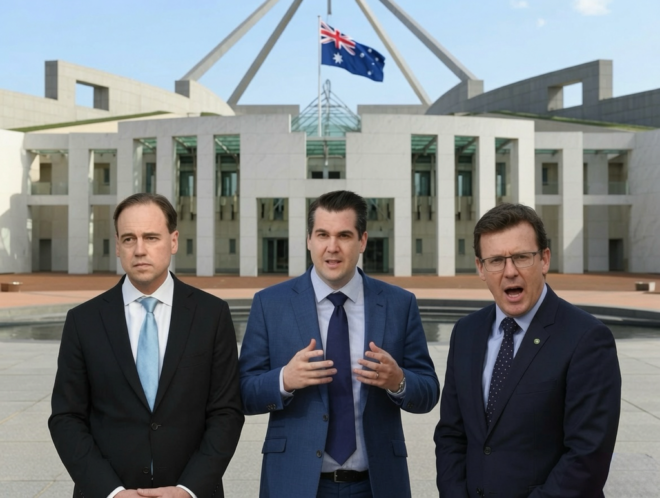
The clearest Australian illustration of this line being crossed, and then walked back, remains the 2017 Victorian episode. Following a Court of Appeal hearing on sentencing appeals in terrorism-related matters including DPP v Besim, three Coalition ministers – Greg Hunt, Alan Tudge and Michael Sukkar – gave public comment characterising the Victorian judiciary as engaged in “ideological experiments” and populated by “hard-left activist judges” whose leniency, in the ministers’ telling, had degraded public confidence in the courts. Crucially, this commentary was published while the Court of Appeal’s decision remained reserved – the single circumstance in which the sub judice risk is at its most acute, because the court has not yet spoken and the suggestion that it ought to reach a particular conclusion is closest to live interference rather than retrospective critique.
The Court of Appeal, constituted by Chief Justice Marilyn Warren with Justices Weinberg and Kaye, did not treat this as ordinary political noise. It issued a formal show-cause order requiring the ministers to explain why they should not face contempt proceedings, and found a strong prima facie case established. Its reasons were unambiguous: the comments reflected, in the Court’s words, an inadequate grasp of why judicial independence from the political branches of government matters to a functioning democracy. The ministers ultimately delivered unqualified apologies and retractions, which the Court accepted as sufficient to purge the contempt without further penalty. No one went to gaol and no minister lost office over it, but the episode has since functioned as a durable marker in Australian legal and political commentary – cited whenever a politician’s remarks about a court edge toward the same territory.
What made 2017 unambiguous was the conjunction of three features rarely all present at once: the proceedings were still active and reserved; the criticism targeted the ideological character of the judges themselves rather than the law they were applying; and the language explicitly invited the inference that a different, harsher outcome was the only legitimate one. Remove any one of those three features and the analysis becomes harder – which is exactly the position the Taylor intervention occupies.
2026: The El Houli Bail Decision
In July 2026, Magistrate Brett Sonnet of the Melbourne Magistrates’ Court granted bail to Rayann El Houli, a 34-year-old mother of four charged with travelling to a declared conflict zone and joining Islamic State, following her years of detention in Syria after the collapse of IS territory and her return to Australia earlier in the year. The prosecution opposed bail, citing an unacceptable risk to community safety and alleging El Houli had filmed herself exposing her children to extremist propaganda. Magistrate Sonnet granted bail regardless, weighing the historical nature of the alleged conduct (dating to 2014), El Houli’s role as primary carer, her compromised health including post-traumatic stress disorder and a possible diagnosis of multiple sclerosis, the absence of prior offending, roughly eight months already spent living in the community without incident, and her cooperation with authorities. He assessed the risk of reoffending as relatively low and imposed more than a dozen conditions, including reporting to police five times weekly, surrender of travel documents, participation in a de-radicalisation program, and restrictions on movement near places of worship and on internet access.
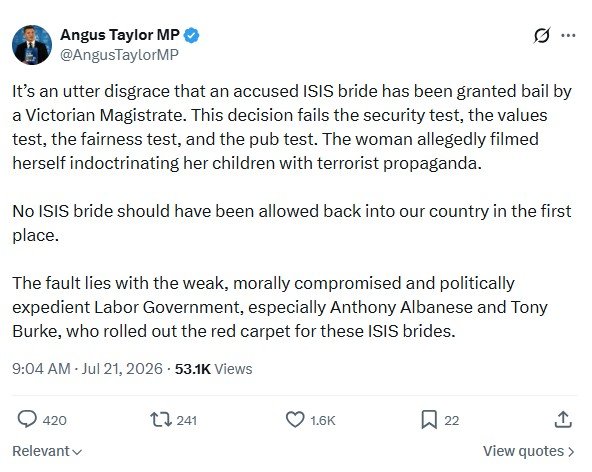
Angus Taylor – since February 2026 the Leader of the Opposition, not a backbench minister as in 2017, but the alternative Prime Minister – responded on his own social media account in terms considerably sharper than anything he offered when merely commenting on repatriation policy earlier in the year. In full: “It’s an utter disgrace that an accused ISIS bride has been granted bail by a Victorian Magistrate. This decision fails the security test, the values test, the fairness test, and the pub test. The woman allegedly filmed herself indoctrinating her children with terrorist propaganda. No ISIS bride should have been allowed back into our country in the first place. The fault lies with the weak, morally compromised and politically expedient Labor Government, especially Anthony Albanese and Tony Burke, who rolled out the red carpet for these ISIS brides.”
That the office speaking is now Leader of the Opposition rather than a portfolio minister matters to the analysis, and in a direction that should not be understated. A first-instance magistrate weighing whether the alternative Prime Minister of the country has just publicly demanded a different outcome sits under a different kind of institutional pressure than one weighing the views of a single minister among many. The 2017 ministers spoke with the authority of office but not of leadership; Taylor speaks, in effect, for the government-in-waiting. If the sub judice and scandalising principles exist to protect the public’s confidence that verdicts do not bend to power, the seniority of the speaker is not a mitigating factor – it is the whole reason the principle exists.
Reading The Line: Convergence And Divergence
Set against the 2017 template, the Taylor statement diverges on the two features that made 2017 legally unambiguous, and converges on a third that 2017 did not even test.
First, timing. Sonnet’s decision had already been delivered when Taylor spoke. This removes the sharpest form of sub judice risk – there was no reserved judgment left to prejudice, and no danger that a court weighing an outcome would read the statement before ruling. The residual contempt exposure for post-decision commentary is real but considerably attenuated compared with 2017’s timing, where the ministers spoke into an active vacuum the Court of Appeal had not yet filled.
Second, target. Taylor’s closing lines direct blame explicitly at “the weak, morally compromised and politically expedient Labor Government, especially Anthony Albanese and Tony Burke” – the executive’s repatriation policy, which is unambiguously a legitimate subject of partisan attack, sitting as it does squarely within executive discretion and parliamentary accountability. Unlike the 2017 ministers, Taylor does not describe Magistrate Sonnet as ideologically captured, activist, or engaged in an “experiment.” The structure of his argument, read charitably, is that a flawed upstream policy decision (permitting the woman’s return) produced a downstream legal consequence (a bail application the courts were then obliged to determine according to ordinary criteria) – and that the proper object of criticism is the policy, not the magistrate applying settled law to the facts before him.
Where the statement converges with, and arguably exceeds, the 2017 problem is in its rhetorical framing of the judicial outcome itself – though this requires tracing the mechanism rather than simply asserting it. Start with what Magistrate Sonnet was actually required to decide: whether an unacceptable risk existed under the Bail Act, assessed against the specified statutory factors. That is a bounded legal question with a defined answer procedure, however contestable the outcome in a given case. The “pub test,” by contrast, has no defined content at all – it is, by its own long-standing usage in Australian politics, a stand-in for whatever an ordinary person’s gut reaction is presumed to be, unconstrained by evidence rules, statutory criteria, or the facts a court is confined to. To say a legal decision “fails” that test is therefore not simply to criticise the outcome; it is to apply a different, and incompatible, standard of correctness to it – one that measures the decision against presumed popular reaction rather than against the statutory criteria the magistrate was required to apply. That substitution does more work than ordinary outcome-criticism. Criticising a decision as too lenient, or arguing that the Bail Act’s criteria are miscalibrated for terrorism-related offending, leaves the authority of the legal standard itself intact. Measuring the decision against the pub test instead tells the public that the relevant benchmark was never the legal one. While politicians frequently invoke community expectations when advocating legislative change, applying the pub test directly to a magistrate’s application of existing law still invites the public to judge judicial outcomes by a standard the law itself does not recognise. That is a narrower and more precise problem than accusing a judge of ideological bias, as the 2017 ministers did, but it belongs to the same family of error – it invites the public to expect judicial outcomes to track sentiment rather than statute, an expectation that is corrosive once normalised regardless of which political side benefits from it in a given case.
A Bipartisan Pattern, Not A Partisan One
Before assessing Taylor’s statement on its own terms, it is worth being honest about the wider pattern it sits within, because even-handedness demands it. Strong, public, personally framed criticism of bail and sentencing outcomes in terrorism and serious violent crime matters is neither new nor confined to one side of Australian politics. Labor figures in state and federal government have, at various points, criticised sentencing outcomes in terms nearly as blunt as anything discussed here – describing particular results as failing to reflect community expectations, or as requiring urgent legislative correction – including in matters far removed from terrorism. The Coalition ministers rebuked in 2017 were not applying some uniquely conservative form of pressure; they were doing, more crudely and at a worse moment, something governments and oppositions of both persuasions do routinely when a case captures public attention. This history matters to how the Taylor statement should be read, because it means the line between legitimate democratic accountability and improper pressure on the judiciary is not a bright rule but a recurring judgment that reasonable observers, including reasonable lawyers, can and do disagree about. That contestability is not a reason to abandon the analysis; it is a reason to hold the conclusions in this essay with appropriate humility, and to recognise that the 2017 episode is unusually clear-cut precisely because such clarity is the exception in this area, not the rule.
The Case For Taylor: A Fair Hearing
An honest treatment of this question has to steelman the position before critiquing it, and there is a genuine case to be made in Taylor’s defence, not merely a cynical one.
Opposition leaders are elected, in part, to hold government to account for policy choices with life-and-death stakes, and the repatriation of Australians who joined a designated terrorist organisation is about as high-stakes as policy gets. Nothing in the separation of powers doctrine requires politicians to fall silent about decisions that place accused terrorism offenders back in the community, nor does it require them to pretend that a bail outcome exists in a policy vacuum divorced from the antecedent decision to allow return in the first place. Taylor’s central causal claim – that this bail hearing would not exist at all but for the government’s repatriation policy – is not a legal argument about the magistrate’s reasoning; it is a policy argument about the executive’s prior choices, and Chapter III has nothing to say against ministers or opposition leaders being criticised for policy. It is also true that Taylor did not, unlike the 2017 ministers, accuse the judiciary of ideological capture, and the absence of that specific charge is not a small distinction – it is arguably the difference between contempt exposure and ordinary political noise, however uncomfortable that noise.
There is a further point in Taylor’s favour worth taking seriously: strong public reaction to bail decisions in terrorism matters is not, by itself, evidence of a threat to judicial independence. Citizens and their representatives are entitled to find a legal outcome troubling, to say so loudly, and to demand legislative reform of bail tests they believe are miscalibrated for this category of offending, all without any of that constituting an attack on the judiciary’s institutional legitimacy. If Taylor’s statement had stopped at “this decision troubles me and Labor’s repatriation policy is the reason it arose,” no one would credibly suggest a separation of powers problem existed at all.
Why The Distinctions Do Not Fully Dissolve The Risk
The difficulty is that Taylor’s statement did not stop there, and the language he chose does independent work beyond the policy critique it is nested within. “Utter disgrace,” applied not to the government’s policy but grammatically and immediately to “a Victorian Magistrate” having “granted bail,” personalises the criticism onto the judicial act itself, not merely its policy antecedent. The subsequent list of “tests” the decision supposedly “fails” reinforces rather than dissolves that personalisation – a decision cannot fail the “pub test” in the abstract; only a decision-maker’s judgment can, and the decision-maker here was Magistrate Sonnet, exercising Chapter III-adjacent judicial power under state law according to the criteria Parliament gave him.
This is where the seniority point returns with force, though its practical weight is necessarily more prospective than immediate. A single minister’s intemperate remark carries the institutional weight of one portfolio. A statement from the Leader of the Opposition – a person one election away from directing the executive that appoints, funds and legislates for the courts – carries the implicit suggestion that a change of government might carry consequences for how the judiciary is treated or spoken about. Nothing in Taylor’s statement makes an explicit threat of that kind, and it would be unfair to suggest otherwise. But the doctrine of separation of powers is concerned with appearances as much as intentions, precisely because public confidence in judicial impartiality is what is at stake, not merely the private motives of the speaker. A magistrate does not need to believe Taylor intends to interfere with the judiciary to feel the institutional weight of being denounced, by name of office if not by name, by the person who may soon control the mechanisms of judicial appointment and court funding.
The Comparative Frame
Australia is not alone in wrestling with this tension, and the comparative picture cautions against complacency about where unchecked rhetoric leads. The pattern of senior political figures publicly denouncing individual judicial officers by name over specific rulings, escalating over time from criticism of decisions to criticism of the judges’ fitness for office, has been visible in other common law democracies in recent years, most conspicuously in the United States, where sustained executive-branch attacks on named federal judges over adverse rulings have drawn public rebukes even from within the judiciary’s own conservative wing, including from a sitting Chief Justice. The Australian instances discussed here sit well short of that pattern – no politician here has called for a judge’s removal, questioned their legitimacy to hold office, or attacked them by name – but the trajectory in other jurisdictions is a reminder that the boundary tested in 2017 and again in 2026 is not self-enforcing. Australia’s stronger institutional norms make outright escalation less likely, but the underlying tension remains real. It holds because courts are willing to say something when it is approached, and because political actors, so far, have been willing to retreat when told they have gone too far. Neither of those conditions is guaranteed to persist merely because they have held until now.
Conclusion: The Weight Of The Office
Separation of powers functions as a guardrail precisely because it is boring when it is working. Courts decide cases according to law, politicians criticise policy, and the two activities do not visibly collide. The 2017 Victorian episode showed what happens when that boundary is breached plainly – reserved proceedings, direct allegations of judicial ideology, and a formal contempt process that ended only with apology. The Taylor intervention of 2026 sits in genuinely more ambiguous territory: later in timing, more careful in nominally directing blame at government policy rather than judicial character, but employing language – “utter disgrace,” the “pub test” – that still measures a specific judicial officer’s application of settled law against the yardstick of popular sentiment rather than legal criteria, and does so from an office of far greater institutional consequence than any of the 2017 ministers held.
None of this means Taylor’s remarks were unlawful, or that a court would find contempt if the question were formally tested; the post-decision timing and the primary focus on executive policy make that a considerably harder case than 2017 was. But the separation of powers doctrine was never only a legal threshold to be crossed or avoided. It is also a norm of restraint that senior political figures are expected to observe because they, more than most, shape what the public comes to expect as normal. When the alternative Prime Minister frames a magistrate’s lawful application of the Bail Act as failing a “pub test,” he does not commit contempt of court. He does, however, lend his considerable authority to the proposition that judicial outcomes should be judged against popular sentiment rather than against the law the magistrate was required to apply. That proposition, if normalised, is exactly the slow erosion the guardrail was built to prevent.
There is a cleaner path available, and it is worth stating plainly: the two legitimate avenues of criticism identified earlier in this essay are not merely alternatives Taylor could have chosen – they are the preferable form his intervention should have taken. He could have confined himself to arguing that the Bail Act’s criteria are miscalibrated for terrorism-related offending and require legislative reform, a position squarely within Parliament’s competence and one that leaves the magistrate’s application of existing law untouched. Or he could have confined himself to holding the Albanese Government to account for the repatriation policy that made the bail hearing possible in the first place, a position that targets executive discretion rather than judicial reasoning. Either path lets Taylor make his substantive case with full force, loses none of its political sting, and does so without measuring a magistrate’s lawful decision against a standard – the pub test – that the law does not recognise and was never his to apply. That the sharper, riskier version of the statement was chosen instead is the real subject of this essay’s concern: not that Taylor lacked lawful room to criticise, but that he used more of the room than the guardrail can comfortably absorb, when a narrower version of the same argument was available and would have served his political purpose just as well.
– – –
Bakchos is the founder of Blak and Black, an Australian media and advocacy platform established in 2010. Bakchos writes from the intersecting perspectives of Wiradjuri heritage, Jewish identity, and humanism.
© Bakchos, July 2026



It seems that conservative politicians don’t respect the rule of law or the separation of powers doctrine.
Whitefellas are really good at rigging the system in favour of themselves.
The Liberal Party has a strained relationship with the separation of powers doctrine.